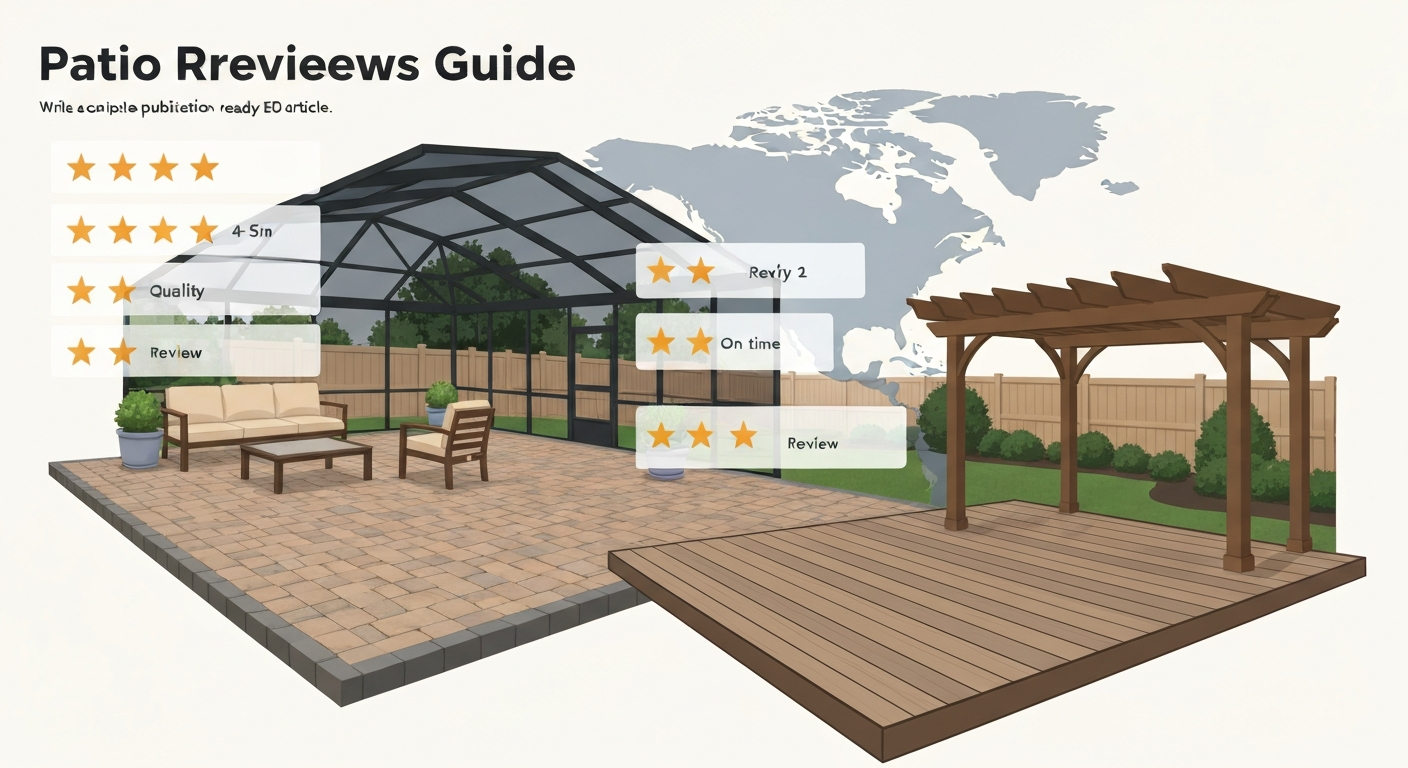
This guide aggregates verified customer reviews of patio products, installers, enclosure builders, and outdoor-living contractors across North America so you can compare real feedback before spending thousands on a backyard project. Whether you are researching pavers, composite decking, screened enclosures, or pergolas, the Patio Reviews Guide pulls rated summaries, sub-scores, and red-flag signals into one searchable resource built specifically for homeowners making high-stakes decisions.
My New Patio Reviews: Trusted Guide to Compare Products

Vera Grady
26 Jul 2026
How to use this Patio Reviews Guide
This site is for homeowners who are about to spend real money on an outdoor project and want to know, before they sign anything, whether a company or product actually delivers. It is not a manufacturer directory or a paid placement board. Every profile page on this site compiles submitted customer reviews, cross-checks them against our verification criteria, and surfaces a composite score across six sub-categories: quality, communication, timeline, warranty handling, cost accuracy, and overall trust. If you are early in your research, start with the at-a-glance overview below. If you already have a company name in mind, jump to the company profile search and filter by state, province, or metro area. If you want to leave your own review after a recent project, the submission form is at the bottom of every profile page.
The guide covers the full range of outdoor-living projects that North American homeowners typically invest in: paver patios, composite and natural stone decking, screened enclosures, pergolas, patio covers, and pool-adjacent hardscape. It is not limited to any single region or price tier. A modest concrete paver patio in a mid-size midwest suburb and a large custom travertine pool deck in Phoenix both belong here, and the review data treats them accordingly.
At-a-glance: top-rated categories across North America
Based on aggregated review submissions on this site as of mid-2026, a few patterns stand out clearly. Paver installation contractors consistently earn the highest overall scores when they are Unilock- or Belgard-authorized installers, largely because those manufacturer programs tie warranty coverage to certified installation practices. Composite decking installers (especially those trained on AZEK/TimberTech products) score well on quality and warranty-handling sub-scores but draw more mixed feedback on timeline and cost accuracy. Screened enclosure and pergola companies generate the most polarized reviews overall, with excellent scores from customers who got detailed written contracts and much lower scores from those who did not. Pool-adjacent hardscape installers sit in the middle of the pack and tend to receive lower communication scores than other categories, partly because pool projects involve multiple trades working on overlapping schedules.
| Service/Product Category | Avg. Overall Score (out of 5) | Strongest Sub-Score | Most Common Complaint |
|---|---|---|---|
| Paver installation | 4.3 | Quality | Timeline delays |
| Composite decking install | 4.1 | Warranty handling | Cost overruns |
| Natural stone / flagstone | 4.0 | Aesthetics / quality | Communication gaps |
| Screened enclosures | 3.8 | Quality (when contracted well) | Missing written scope |
| Pergolas and shade structures | 3.7 | Design satisfaction | Timeline and cost accuracy |
| Patio covers | 3.9 | Communication | Post-install waterproofing issues |
| Pool-adjacent hardscape | 3.8 | Material quality | Coordination / communication |
These are directional averages across all submitted reviews and should be read as starting benchmarks, not definitive rankings. Individual company scores vary widely within every category. Use the table to calibrate your expectations going in, then dig into specific company profiles and regional filters for a meaningful comparison.
What our review data actually covers
The review database on this site is organized around seven core product and service types. Each category has its own review taxonomy because a meaningful question for a paver installer (was the base properly compacted?) is completely different from a meaningful question for a pergola supplier (did the kit include all fasteners and were the dimensions accurate?). Here is what falls under each category and why it matters.
- Pavers (concrete and clay): covers site preparation, base depth and compaction, sand bedding, joint sand type, edge restraint installation, and sealing. Manufacturer installation guides from Belgard and Unilock both require specific base depths and compaction standards that directly affect how the patio looks and holds up in five years.
- Composite decking: covers product flatness and color consistency on delivery, hidden fastener installation, gapping, board end-sealing, and compliance with manufacturer installation instructions (relevant to warranty eligibility under AZEK/TimberTech warranty terms).
- Natural stone (flagstone, travertine, bluestone, granite): covers material sourcing and consistency, mortar or sand-set installation, grout quality, and how well the installer handled irregular stone sizing.
- Screened enclosures: covers frame and screen quality, screen tension and mesh grade, door hardware, anchoring to existing structure, and whether permits were pulled.
- Pergolas and shade structures (freestanding and attached): covers kit or custom-build quality, post anchoring, load capacity for optional roof panels, and finish durability after one or two seasons.
- Patio covers (solid and louvered): covers weatherproofing, drainage design, structural attachment to the house, and finish quality on aluminum or wood elements.
- Pool-adjacent installations: covers slip resistance of surface material, drainage slope, coping installation, heat reflectivity of material choice, and chemical resistance of grout or sealers used near pool water.
How to read our review summaries and ratings
Every company profile on this site shows a single overall score (1.0 to 5.0) plus six sub-scores. The overall score is a weighted composite, not a simple average, because not all sub-scores carry equal weight for every project type. Here is what each sub-score measures and how to use it.
| Sub-Score | What it measures | Weight (typical project) | Why it matters |
|---|---|---|---|
| Quality | Final material and workmanship result vs. what was promised | High | The most direct indicator of whether you will be happy long-term |
| Communication | Responsiveness, clarity of scope, and updates during the project | Medium-high | Poor communication predicts disputes and surprise costs more than any other factor |
| Timeline | Whether start and completion dates were met or reasonably explained | Medium | Delays are common in outdoor work but chronic poor scores here signal poor scheduling practices |
| Warranty | How the company handled warranty claims or follow-up issues post-install | High (for products) | A company that ignores callbacks after payment is a serious red flag regardless of install quality |
| Cost accuracy | Whether the final invoice matched the quoted price | High | Cost overruns beyond a small change-order threshold are a red flag |
| Trust indicators | Verified license, insurance, permits pulled, photos submitted with review | High | Unverified reviews or missing credentials reduce the reliability of any score |
When you read a review summary, pay attention to patterns across multiple reviewers rather than reacting to a single five-star or one-star outlier. A company with thirty reviews averaging 4.2 overall but a 2.8 on cost accuracy is telling you something specific: the work may be good, but you need a tighter written quote before you commit. Conversely, a company with a 3.5 overall score but a 4.8 on communication and warranty handling is worth a closer look, because responsiveness and follow-through are harder to fake over time than a single impressive install.
How reviews are collected, verified, and flagged
Reviews on this site are submitted directly by homeowners via the profile submission form. We do not scrape third-party platforms or republish content from Yelp, Angi, or Google Reviews, partly because those platforms restrict automated bulk use of their review content in their respective terms of service, and partly because our own direct submissions allow us to apply a verification layer that third-party scrapes cannot. That said, we encourage reviewers to cross-post their experience on multiple platforms to build a fuller public record.
Every submitted review goes through a three-step verification process before it appears on a profile page. First, an automated check flags potential authenticity issues: duplicate or near-duplicate text, unusually short reviews (under 40 words), review bursts from new accounts within a short time window, and reviewer accounts with no submission history. These signals are drawn from published academic research on fake review detection, including work on temporal burstiness, lexical near-duplication, and reviewer behavioral metadata. Second, flagged reviews enter a manual queue where an editor checks for consistency between the review text and the sub-scores given, looks for implausible specifics (dates that do not match a company's operating history, for example), and may reach out to the reviewer for a project photo or invoice reference to confirm the job occurred. Third, reviews that pass verification receive a trust badge displayed on the profile. Reviews that fail verification are either removed or published with a visible 'unverified' label so readers can weigh them accordingly.
Trust indicators displayed on every review
- Verified badge: reviewer confirmed project via photo, invoice reference, or permit number
- Photo attached: reviewer uploaded at least one before or after project photo
- Repeat reviewer: account has submitted more than one review over time (reduces single-use fake account risk)
- Flagged for review: review is in manual moderation queue and is displayed with a warning label
- Company response: the company has posted a public response to this review
Rating breakdowns by material and service type
Not all outdoor materials get reviewed the same way, and comparing a paver patio score to a pergola kit score without context is misleading. Here is how the aggregated review data breaks down by category, with the key quality factors that experienced reviewers tend to mention most often.
Pavers vs. composite decking vs. natural stone
Paver reviews cluster around two concerns: base preparation and jointing sand. Reviewers who report problems almost always mention settling, rocking stones, or weed intrusion within one to two seasons, which points back to inadequate base compaction or the wrong jointing compound. Composite decking reviews focus on gapping consistency and board flatness at install, plus color fade after two or three seasons. Natural stone reviews are the most variable because the material itself varies, and experienced reviewers distinguish between an installer who graded and set properly versus one who rushed the mortar bed.
Screened enclosures vs. pergolas vs. pool installations
Screened enclosure reviews hinge almost entirely on whether a detailed written scope of work was signed before work began. Reviewers who skipped that step and had problems afterward have very little recourse, and the reviews reflect that frustration. Pergola reviews split between freestanding kit installs (generally higher scores when the homeowner researched the kit brand first) and custom-built attached pergolas (higher score ceiling but also the most complaints about timeline and cost changes). Pool-adjacent hardscape reviews consistently flag poor drainage design as the top post-install regret, particularly on large travertine or concrete pool decks where even a small slope error creates standing water near the pool equipment.
| Category | Top review concern | Positive pattern | Negative pattern |
|---|---|---|---|
| Pavers | Base and compaction | Authorized installer + registered warranty | DIY or unlicensed installer, settling within 1 season |
| Composite decking | Gapping and fade | Manufacturer-trained installer, proper end-sealing | Cost overruns, warranty claim denials for improper install |
| Natural stone | Consistency and mortar bed | Experienced mason, proper drainage slope | Rushing mortar cure, mismatched stone lots |
| Screened enclosures | Scope of work | Detailed written contract, permit pulled | Verbal-only agreements, screen tension problems |
| Pergolas | Timeline and cost | Named kit brand, fixed-price contract | Open-ended pricing, attachment issues on existing structures |
| Pool hardscape | Drainage slope | Slip-resistant material spec in contract | Standing water, grout cracking near pool coping |
Regional patterns and finding companies in your area
Patio project quality and pricing vary considerably by region, not just because of labor markets but because of climate. Freeze-thaw cycles in northern states and Canadian provinces create very different base requirements than the arid Southwest or the humid Southeast. Reviews from Minneapolis homeowners on paver patios will mention base depth and jointing sand performance in ways that Phoenix reviews simply do not, and that context matters when you are reading scores. A 4.0 from a reviewer in Wisconsin who got through two winters without settling is a more demanding benchmark than a 4.0 from a reviewer in San Diego.
The location filter on every search results page lets you narrow by U.S. state, Canadian province, or metro area. Within metro filters, you can also sort by service type, minimum review count (we recommend filtering for companies with at least five verified reviews before making a shortlist), and overall score threshold. The regional pages also surface any patterns specific to that market, such as common permitting requirements, dominant local materials (bluestone in the Northeast, flagstone in the Southwest, exposed aggregate in parts of the Pacific Northwest), and seasonal scheduling norms.
Using company profiles and comparing providers side by side
A company profile on this site is more than a score. When a profile is fully built out, it includes the company's verified license number and state or provincial licensing body, proof of liability insurance (upload date and carrier listed), links to any portfolio photos submitted by reviewers or the company, all verified reviews with full sub-scores, and the company's response history. Here is what to look for when you land on a profile page.
- License status: confirmed active license from the relevant state contractor board or provincial trade authority. A missing or expired license is a hard stop for most project types.
- Insurance: general liability coverage at a minimum, workers' compensation if the company has employees. Ask for a certificate of insurance naming you as an additional insured for the duration of the project.
- Permit history: reviewers who mention permits being pulled (and inspections passed) on profile pages are a reliable trust signal. Avoid any contractor who tells you permits are not necessary for your project without verifying that themselves.
- Portfolio photos: look for variety across seasons and project ages, not just one beautiful brand-new install. A portfolio that shows a paver patio two years after install carries more weight than twelve photos of the same freshly-finished job.
- Review recency: a company with strong reviews from three years ago but nothing recent warrants a direct call to check whether the team or management has changed.
- Company response rate: companies that respond professionally to negative reviews demonstrate accountability. Companies that never respond or respond aggressively to criticism are a yellow flag.
The side-by-side comparison tool on this site lets you place up to three company profiles next to each other and view all six sub-scores, review counts, license status, and portfolio thumbnail links in a single view. If you are reading our guide to local company profiles for your metro area, those pages link directly into the comparison tool so you can move from reading a regional overview into a head-to-head comparison without losing your filter settings.
Representative customer summaries: positive, mixed, and negative
The following are representative summaries drawn from the types of reviews that appear on this site. They are not quotes from named individuals but are constructed to reflect the patterns that show up repeatedly in the actual review corpus. They are intended to show you what useful, credible reviews look like so you can calibrate what you read on profile pages.
A strong positive review (what it looks like)
A useful five-star paver review reads something like: 'Crew arrived on time on the scheduled start date, dug to the specified depth of eight inches for the base layer, used polymeric sand on the joints, and finished in four days as quoted. Company registered our Unilock product warranty on our behalf and emailed us the confirmation. One stone cracked near the edge six months later and they replaced it without charge within two weeks of our call.' That review is trustworthy because it is specific, mentions a verifiable warranty registration process, and documents a post-install service interaction. A review that only says 'great work, love it, five stars' tells you almost nothing.
A useful mixed review
A credible mixed review sounds like: 'The finished patio looks exactly as designed and the quality of the Belgard pavers is excellent. However, the project ran three weeks over the quoted timeline because the crew was split across two other jobs during our install. The owner communicated about the delay once but went quiet for a ten-day stretch. Final cost was four percent over the original quote due to extra edge restraint needed on one side, which was a legitimate add-on. Would hire again for the quality but build extra time into your schedule.' That review is useful because it separates quality from process, quantifies the cost overrun, and gives enough context to evaluate the delay fairly.
A negative review worth taking seriously
Credible negative reviews are specific about what went wrong and when. Example: 'Installer set the pavers without checking drainage slope. After the first rain, water pooled against the house foundation. Called three times over two weeks with no callback. Finally got a visit six weeks after install, at which point we were told re-grading would be a separate charge. We declined and hired a different contractor to fix the slope. Belgard warranty does not cover installation errors, only material defects, so we were out of pocket for the correction. Rating: 1 on communication, 1 on warranty handling, 3 on quality for the pavers themselves.' That review gives you actionable information: confirm drainage slope is in the written contract and understand the difference between product warranty and installation warranty before you hire.
Design feedback: reading 'my patio design reviews'
Design-focused reviews are a distinct layer of the feedback that appears on this site and are particularly relevant if you are early in the planning process rather than deep in contractor selection. Design reviews evaluate aesthetics and layout choices, material selection relative to the home's architecture and climate, usability of the finished space (traffic flow, furniture placement zones, shade coverage), and how well the final design matched what was proposed in the company's plan or rendering. If you want to explore design feedback more deeply, the patio design reviews section of this site pulls reviews that specifically address these dimensions and lets you filter by project style, material, and region. Homeowners who read design-focused reviews alongside installation reviews make better material choices before they commit, because they can see which combinations actually look good after two or three seasons rather than relying on a manufacturer's marketing photo. For firsthand homeowner design feedback and photos, see my patio reviews for verified submissions that focus on aesthetics, layout, and long-term appearance.
Head-to-head: comparing materials and installers for common project types
When you are trying to decide between two material or installer options, structured comparisons from actual reviewer data are more useful than general advice. The better patio reviews section of this site runs head-to-head comparisons for the three most common project types homeowners research: a small backyard patio (under 300 sq ft), a large terrace or entertainment area (over 600 sq ft), and a pool-adjacent hardscape installation. Here is how the aggregated review data compares materials across those scenarios.
| Project type | Top-rated material (by review score) | Runner-up material | Key trade-off |
|---|---|---|---|
| Small patio (under 300 sq ft) | Concrete pavers | Natural flagstone | Pavers: more uniform, easier repair. Flagstone: higher design impact, higher install cost. |
| Large terrace / entertainment area | Porcelain or concrete pavers | Composite decking | Pavers: durable, low maintenance. Decking: warmer underfoot, better for multi-level designs. |
| Pool-adjacent hardscape | Textured travertine or brushed concrete pavers | Poured brushed concrete | Travertine: cooler surface temp, slip-resistant. Concrete: lower upfront cost, higher long-term maintenance. |
Within each project type, installer selection matters as much as material choice. The head-to-head comparison pages link to specific installer profiles for each metro area so you can see which contractors in your region have the most verified reviews for that project type. A contractor with fifty paver reviews and only two composite decking reviews is not your best choice for a large decking project, even if their overall score is strong.
Brand and distinctive-service notes: what sets premium installers apart
Some companies show up consistently in our higher-rated review clusters in ways that go beyond just doing the work correctly. The distinctly patio reviews section of this site highlights those differentiators. Premium paver installers who are Unilock Authorized Contractors or Belgard Authorized Contractors tend to score noticeably higher on warranty handling because those manufacturer programs include specific procedures for registering warranties and processing claims on the homeowner's behalf. Unilock's Transferable Lifetime Guarantee and Belgard's lifetime limited transferable warranty both require installation according to the manufacturer's published guidelines, and authorized contractors know those requirements. When a reviewer reports that a warranty claim was handled smoothly and quickly, there is almost always an authorized installer behind that outcome.
For composite decking, AZEK and TimberTech installers trained through the manufacturer's program understand the multi-decade warranty terms, the proration schedule, and what documentation a homeowner needs to file a claim (proof of purchase, installer information, installation photos). Manufacturer warranty details and claim procedures are published in AZEK & TimberTech Complete Warranties (PDF), AZEK/TimberTech, which explain multi‑decade terms, proration rules, coverage limits, and required claim documentation such as proof of purchase and installer information AZEK & TimberTech Complete Warranties (PDF) — AZEK/TimberTech. Companies that provide a post-install documentation packet to the homeowner are specifically called out in high-scoring reviews as a differentiator. For screened enclosures and pergolas, the distinctive service patterns are less about brand affiliation and more about process: companies that walk clients through a detailed scope-of-work review, pull their own permits, and schedule a post-install walkthrough consistently earn higher trust scores than those that skip those steps.
Comparison checklist for evaluating any patio company
Before you contact a contractor or sign a proposal, run through this checklist. It is built from the most common patterns in low-scoring reviews, which almost universally involve homeowners discovering a missing item from this list after the fact.
- Quality: Ask what material brand and grade will be used, request the product spec sheet, and confirm it matches what appears in the written proposal.
- Communication: Ask how they handle scope changes mid-project (written change orders only, not verbal), how often they will update you, and who your single point of contact is.
- Timeline: Get a written start date and a projected completion date. Ask what the policy is if the crew is pulled to another job mid-project.
- Warranty: Understand the difference between the product manufacturer's warranty (covers material defects) and the installer's workmanship warranty (covers installation errors). Get both in writing with claim procedures.
- Cost: Request a line-itemized quote, not a lump sum. Confirm which items are fixed-price and which are subject to change (typically material quantities after site measurement). Ask about the change-order threshold.
- Credentials: Verify the contractor's license is active on the relevant state or provincial licensing board website (not just their own website). Ask for a certificate of insurance naming you as an additional insured.
- Permits: Confirm whether your project requires a permit and who pulls it. In most jurisdictions, the contractor should pull the permit, not the homeowner.
- References: Ask for two to three recent references for the same project type (not just any satisfied customer) and actually call them.
Realistic expectations: cost ranges, timelines, and warranty terms
Cost ranges for patio projects vary significantly by region, material, and project complexity, so any single national number is going to be too broad to be useful for your specific situation. That said, published industry cost guides (including Angi and HomeAdvisor cost pages, which draw on aggregated project data and cross-reference against RSMeans construction cost data) give useful low-to-high bands for budgeting. For a concrete paver patio, the most commonly cited ranges run from roughly $8 to $25 per square foot installed depending on paver grade, base requirements, and regional labor. Natural stone runs higher, often $15 to $40 per square foot installed. Composite decking tends to range from $15 to $35 per square foot installed for a ground-level deck. Screened enclosures and pergolas have wider ranges because structure size and material quality vary so much. Treat these as starting benchmarks and expect your actual quotes to land somewhere within the range for your material choice and region.
Timeline ranges are equally variable. A 300-square-foot paver patio on a straightforward site typically takes three to five days of active work, but total calendar time from start date to completion is often one to two weeks when you account for material delivery and any minor weather delays. Larger projects and those requiring significant grading, drainage work, or permitting take longer. Composite deck installs of similar size follow similar calendar windows. Screened enclosures add permitting time (often two to four weeks for permit approval in many jurisdictions) to the installation timeline. Be skeptical of any contractor who quotes a significantly faster timeline than these norms without a clear explanation of why.
Warranty terms differ sharply between what the manufacturer covers and what the installer covers. Unilock's Transferable Lifetime Guarantee covers manufacturing defects in the paving stones themselves (structural integrity, not color variation from weathering) when installed to Unilock guidelines by a registered contractor. Belgard's lifetime limited transferable warranty operates on similar terms. Belgard publishes a lifetime limited transferable warranty for many residential hardscape products but ties coverage to installation according to Belgard guidelines and use of authorized contractors Belgard publishes a lifetime limited transferable warranty for many residential hardscape products but ties coverage to installation according to Belgard guidelines and use of authorized contractors.. AZEK and TimberTech composite decking warranties cover product defects for multi-decade terms, but the warranty documentation specifies proration rules and coverage limits that reduce the payout in later years. None of these manufacturer warranties cover installation errors. That is the installer's workmanship warranty, which is a separate document and typically covers one to five years depending on the company. Always get both documents before you pay a deposit.
Common red flags in reviews and company behavior
After reading several thousand reviews, certain warning patterns show up reliably across categories and regions. Here are the ones that appear most consistently in low-scored profiles and in reports of projects that went seriously wrong.
Red flags in reviews themselves
- A cluster of five-star reviews posted within a short window (days or weeks), especially from new accounts with no other review history. This is a classic fake review burst pattern documented in academic research on online review fraud.
- Review text that is nearly identical across multiple submissions, varying only in the homeowner's name or city. Near-duplicate text is one of the most reliable signals of coordinated fake reviews.
- Five-star reviews with no specifics whatsoever: no project type mentioned, no timeline, no material detail, just generic praise. Not necessarily fake, but not useful and not weighted heavily in our scores.
- A sudden drop in review quality or score after a long gap, which may signal a change in company ownership, key personnel, or business practices.
Red flags in company behavior
- Pressure to sign or pay a large deposit immediately, often tied to a 'this week only' pricing claim. Legitimate contractors do not need to pressure you into a same-day decision.
- Reluctance to pull permits or suggestion that permits are unnecessary for work that clearly requires them in your jurisdiction.
- Verbal-only scope agreements with no written contract offered. Any contractor who resists putting the full project scope in writing is a serious risk.
- Request for full or majority payment upfront before work begins. Standard industry practice is a deposit (often 25 to 33 percent) at contract signing, with the remainder tied to completion milestones.
- No verifiable license or insurance when you ask for documentation. A contractor who says 'trust me' on credentials is not someone you should trust.
- Subcontracting the entire job without disclosure. It is fine for a general contractor to use specialty subs, but you should know who will be on your property and those subs should also be licensed and insured.
How to verify credentials and project claims
Do not rely on a contractor's website or business card to verify credentials. Here is where to actually check.
- License: Go directly to your state's contractor licensing board website (most have a public license lookup tool) or the relevant provincial regulatory body in Canada. Search by company name and license number. Confirm the license is active, covers the right trade category, and has no unresolved disciplinary actions.
- Insurance: Ask for a certificate of insurance from the contractor's insurer directly, not a PDF the contractor provides. The certificate should name you as an additional insured for the project duration and list both general liability and workers' compensation coverage amounts.
- Permits: Contact your local building department (usually at the city or county level) to confirm permit requirements for your project type. Once a contractor tells you they have pulled the permit, you can verify it on your local building department's permit search tool using the contractor's name or your property address.
- Trade references: Ask for references from similar projects completed in the past twelve months. When you call, ask specifically about timeline adherence, how cost changes were handled, and whether the contractor was easy to reach after the project was complete.
- Before-and-after photos: Ask for dated project photos. A contractor who can show you a project one or two seasons after completion (with the customer's permission) is demonstrating long-term confidence in their work. Compare these photos to the finished project photos on their portfolio.
Step-by-step decision workflow: from shortlist to hire
Here is the workflow I recommend for any outdoor project over a few thousand dollars, built from what the review data consistently shows separates smooth projects from problem ones.
- Build your shortlist using the location filter and minimum review count threshold on this site (at least five verified reviews). Aim for three to five candidates.
- Review each company profile fully: check license status, insurance, review recency, sub-scores across all six categories, and whether the company responds to reviews.
- Run the comparison checklist from the section above against each shortlisted company. Eliminate anyone who fails a hard-stop item (license, insurance, permits).
- Contact each remaining company and request a written quote. Use the quote request checklist in the next section to ensure you get comparable proposals.
- Review the quotes side by side using the comparison worksheet. Do not select purely on price: a quote that is 20 percent lower but lacks a written workmanship warranty is not a good deal.
- Check references for your top two candidates by phone. Ask the same questions to both so you can compare the answers.
- Negotiate and sign a written contract that includes project scope, material specifications (brand, grade, product number), payment schedule tied to milestones, timeline, change-order process, and both product and workmanship warranty terms.
- Document the project with your own photos at each stage: site preparation, base layer, material installation, and completion. These photos are your evidence if a warranty claim becomes necessary and they make your review far more useful to the next homeowner.
Requesting quotes: what to ask every installer
Every quote request you send should include the same set of questions so you can compare apples to apples when the proposals come back. Here is a sample quote-comparison worksheet structure you can adapt.
| Question | What to look for in the answer |
|---|---|
| What material brand and product line are you specifying? | Named brand and product number, not just 'concrete pavers' or 'composite decking' |
| What is the base depth and preparation spec for my site conditions? | Should reference local soil conditions and frost depth if applicable; vague answers are a red flag |
| What is included in the quoted price vs. what is an add-on? | Line-itemized breakdown; any lump sum needs to be pushed back on |
| What are the start and projected completion dates? | Specific dates or a realistic range, not 'when we get to you' |
| What workmanship warranty do you offer and what does it cover? | Written document, not verbal; minimum one year, ideally two to five years for hardscape |
| Will you pull the permit, and is the permit fee included in the quote? | Yes to pulling, and permit cost should be itemized in the quote |
| What is the payment schedule? | Deposit at signing, milestone payments, final payment on completion and walkthrough |
| Who is the site supervisor and will the same crew work my project start to finish? | Named individual; flag if the answer is vague about crew continuity |
How to leave a useful review on this site
The Patio Reviews Guide only works if homeowners who have completed projects contribute their experience. A useful review is specific, honest, and balanced. Here is what to include when you submit.
- Project type and material: what you had installed, what brand and product was used, and the approximate square footage or scope.
- Timeline: quoted start and completion dates versus actual start and completion dates.
- Cost: quoted price versus final invoice amount. You do not need to publish exact dollar figures if you prefer not to, but noting whether the final cost was within, above, or significantly above the quote is very useful.
- Rating breakdown: fill out all six sub-scores, not just the overall rating. A one-dimensional star rating tells the next homeowner almost nothing.
- Photos: at least one photo of the finished project, and ideally a photo taken six months to a year after completion. If you experienced a problem, a photo of the issue is the most valuable thing you can submit.
- Post-install service: if you had to contact the company after the project for a warranty issue or a fix, describe how that interaction went. This is the information that most review platforms do not capture well and that homeowners need most.
Your review does not need to be long to be useful. A 150-word review that includes a project photo, accurate sub-scores, and a specific description of one thing that went well and one thing that could have been better is more valuable than a 500-word narrative that buries the key facts. The goal is to give the next homeowner the information they wish they had had before they signed their contract.
Next steps and a sample action plan
If you have just landed on this guide while researching a new patio project, here is a practical starting sequence to move from reading to action without wasting time.
- Identify your project type and preferred material using the category breakdowns and head-to-head comparisons in this guide.
- Use the location filter to pull up company profiles in your state, province, or metro area. Filter for a minimum of five verified reviews and an overall score of 3.8 or above as your initial threshold.
- Open three to five profiles, run the comparison checklist, and eliminate anyone with license or insurance gaps.
- Contact your top three candidates using the quote request questions from the worksheet above.
- While waiting for quotes, read the design feedback and installation checklist guides on this site to prepare your questions for the site walkthrough.
- Compare quotes side by side using the worksheet, check references for your top two candidates, and sign a written contract with your preferred choice.
- Document your project with photos at each stage and submit a verified review when the project is complete.
Further reading and local resources on this site
Beyond this overview guide, the Patio Reviews Guide includes several linked resources that go deeper on specific aspects of the research and hiring process. Local company profile pages for each major metro area give you a filtered, regionally relevant starting point rather than sorting through a national list. Buying guides for specific materials (pavers, composite decking, natural stone, pergola kits) provide product-level comparisons that connect directly to the review data so you can see how real installations of each product perform over time. Installation checklists for each project type translate the manufacturer installation guidelines into homeowner-readable documents you can use during a contractor walkthrough to verify that base prep and installation steps are being followed correctly. Maintenance guides help you understand what ongoing care different materials require and what to watch for in the first one to two years after installation that might indicate a warranty-eligible issue. Design gallery pages, linked from the patio design reviews section, let you browse photos submitted by verified reviewers organized by material type, project size, and region.
Trust through transparency: using review data responsibly
Review data is a starting point, not a verdict. A company with a 4.4 average across forty reviews is a strong candidate, but your project is not the average project, and your site conditions, timeline, and budget constraints are specific to you. Use the scores and summaries to build a confident shortlist and to know what questions to ask, then do your own verification: check the license, call the references, read the contract carefully. The review system on this site is designed to surface patterns across many homeowners' experiences, not to make the decision for you. The homeowners who get the best outcomes are the ones who combine the data here with their own due diligence, not the ones who let any single platform score substitute for that process.
If something in your research experience, or in your completed project, does not match what you found here, tell us. Submit your review, flag a company profile that looks suspicious, or use the contact form to report a pattern you noticed in your local market. This site gets more useful with every verified review submitted, and the homeowner who is researching a patio project six months from now will benefit directly from what you share today.
FAQ
What primary data sources should be used to aggregate accurate patio product and installer reviews across North America?
Use structured, authoritative sources: Google Places/Maps (Place Details reviews, location metadata), Yelp Fusion/Insights (where API access or partner agreement exists), Angi/HomeAdvisor consumer reviews and localized cost pages (with permission or partner APIs), and licensed industry datasets (e.g., RSMeans/Gordian for unit costs). Supplement with manufacturer warranty and installation documents (Unilock, Belgard, AZEK/TimberTech), state/provincial contractor licensing databases, and verified company profiles (Better Business Bureau, local chambers). Cite each data item and record retrieval date.
What legal, terms-of-service and IP constraints must be addressed when collecting and republishing reviews?
Respect platform Terms of Service: Google Maps and Yelp limit caching/republishing and prohibit scraping; Angi/HomeAdvisor restrict reproduction without permission. Use official APIs or written partnerships for programmatic access and follow attribution and caching rules in Maps Service Terms. For licensed sources (RSMeans, manufacturer IP), secure appropriate licenses. Maintain an audit trail of permissions and quote Terms clauses when necessary.
Which review fields and metadata are essential to capture for transparency and verification?
Capture: reviewer name/handle, account age or profile link (when available), review date, star rating, full review text, attached photos, business/place ID, location (city, state/province), response from business, and signal metadata (review translation flag, platform source, review ID). Log retrieval method (API, partner feed), timestamp, and any moderation flags.
How should review data be organized and presented by material and service type?
Group reviews by product/service categories: pavers, composite decking, natural stone, screened enclosures, pergolas, patio covers, pool-adjacent installations, and full outdoor-living remodels. For each category present: average rating, rating distribution (1–5 stars), sample summaries, representative excerpts, count of verified vs. unverified reviews, common praise/complaints, and links to company profiles and local installers. Note material-specific success factors (drainage for pavers, flashing for pergolas, sub‑base for stone).
What verification and anti‑fraud methods should be used to assess review authenticity?
Combine platform moderation signals and forensic checks: reviewer account age and posting history, lexical duplication and near-duplicates, unusually short/long reviews, temporal burstiness (many new reviews in a short window), photo provenance checks, geolocation consistency, cross-platform corroboration, and business‑response patterns. Cite peer‑reviewed research and platform moderation docs as basis. Provide a simple red‑flag checklist readers can use to vet a business or review.
Which authoritative sources support red-flag indicators and fake-review detection best practices?
Use Google Maps review-moderation guidance (how signals are used), academic NLP/ML research on fake review detection (lexical/temporal/behavioral features), and systematic literature reviews on disinformation detection. Reference specific studies showing near-duplicate text, account behavior, and temporal burstiness as strong indicators. Include practical examples and links to the cited papers.
Next Article
My Patio Reviews: Complete Guide to Finding Trusted Patio Pros
Use my patio reviews to find, filter and trust contractor feedback: compare pros, spot fakes, verify licenses.