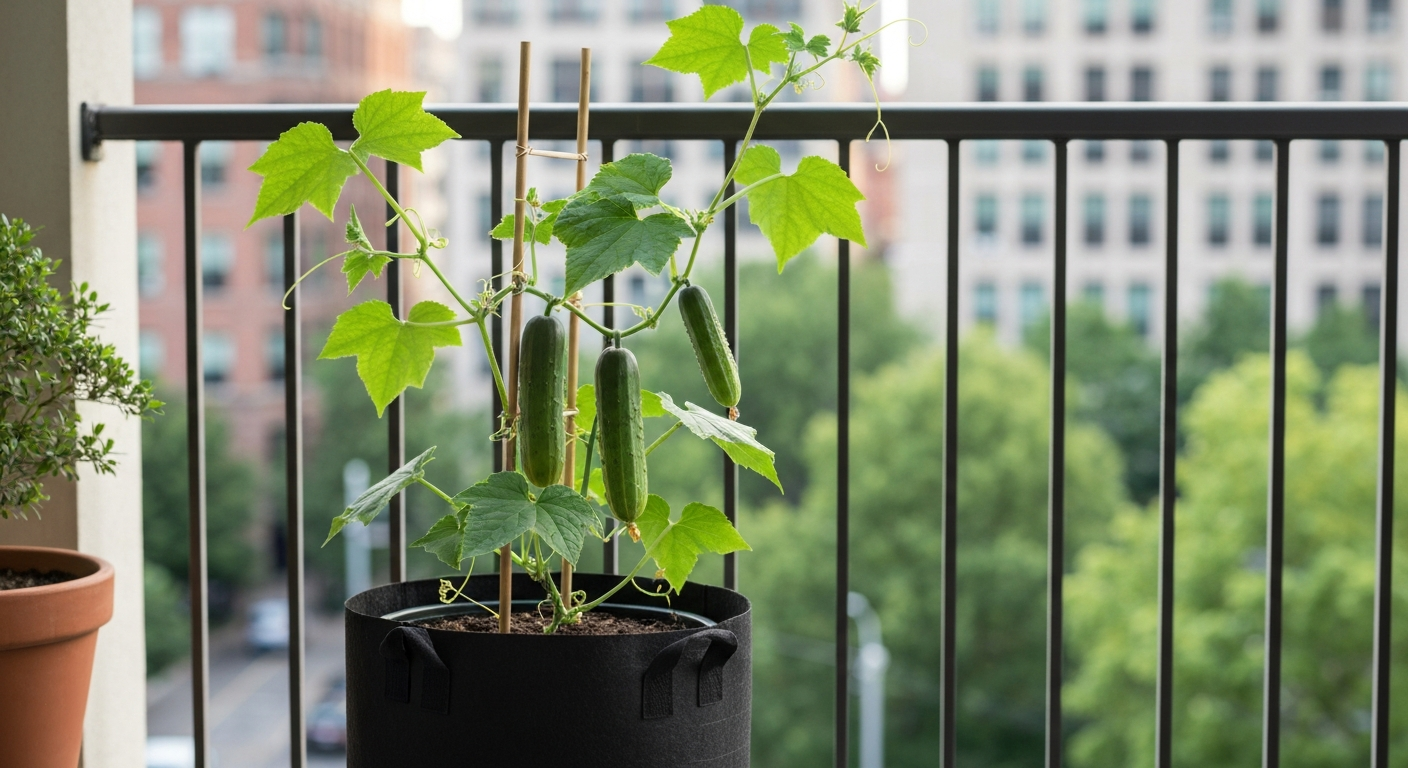
Patio Snacker is a compact F1 hybrid slicing cucumber (Cucumis sativus) bred specifically for containers and small trellises. It produces 6–8 inch fruit in 50–55 days from direct seed, sets fruit without pollinators thanks to its parthenocarpic flower type, and stays within a roughly 24–36 inch footprint, making it one of the more genuinely patio-appropriate cucumbers you can buy across North America right now. For most balcony and patio gardeners looking for a reliable, space-efficient slicer, it delivers on its core promise.
Patio Snacker Cucumber Review: Best Container Cucumber

Vera Grady
17 Jul 2026
Quick verdict and score snapshot
Verdict: Patio Snacker earns its name. It is a well-specified, commercially tested hybrid that fits real patio constraints without asking you to sacrifice meaningful yield. That said, it carries no documented disease-resistance ratings in the official PanAmerican Seed catalog, so gardeners in humid climates should plan for powdery mildew management from day one. Overall score: 4.1 out of 5.
| Criteria | Score (out of 5) | Notes |
|---|---|---|
| Germination reliability | 4.5 | Consistent across multiple vendor reports; expect 80–90%+ under warm conditions |
| Days to first harvest | 4.5 | 50–55 days is fast for a slicer; verified by PanAmerican and Territorial trial data |
| Container suitability | 4.5 | Stays within 24–36 in radius; short branching vines work on a small trellis |
| Yield per container | 4.0 | Continuous harvest reported; comparable to larger vines per Territorial Seed trials |
| Flavor | 3.8 | Mild, crisp, typical American slicer; not complex but consistent |
| Disease resistance | 2.5 | No HR/IR codes listed in PanAmerican catalog; plan proactively for PM and DM |
| Value for price | 4.0 | Seeds from ~$7.95/15-pack; live plants available at major retailers seasonally |
| Overall | 4.1 | Solid container cucumber for most North American patio setups |
Pros and cons at a glance
- PRO: Parthenocarpic — sets fruit without pollinators, reliable on covered patios and screened-in spaces
- PRO: 50–55 days to maturity is fast; you can get two successions in a long season
- PRO: Compact vines stay within a manageable footprint for container growing
- PRO: Widely available from independent nurseries, big-box retailers, and online seed sellers across North America
- PRO: Continuous harvest habit means you pick regularly rather than waiting for one big flush
- CON: No documented disease-resistance ratings in official catalog — not ideal for high-humidity climates without a prevention plan
- CON: F1 hybrid — seeds saved from your harvest won't reliably reproduce the same plant
- CON: Live transplants at big-box stores can be inconsistently sourced; quality varies by region and season
What is the Patio Snacker cucumber?
Patio Snacker is an F1 hybrid American slicing cucumber developed by PanAmerican Seed (a brand of Ball Horticultural Company) and marketed through its HandPicked consumer seed line. It is a monoecious, blank" rel="noopener noreferrer">parthenocarpic variety, meaning it produces both male and female flowers on the same plant and can develop fruit without bee pollination, a meaningful advantage if your patio is covered, enclosed with a skeeter screen, or simply short on pollinators. The RHS plant profile corroborates the commercial specs: stems reach about 1. The RHS plant profile (blank" rel="noopener noreferrer">Cucumis sativus 'Patio Snacker' | RHS Plant Profile) lists stems to about 1.5 m (≈5 ft) and fruit around 20 cm (≈8 in) long, corroborating the cultivar's compact habit and typical fruit size. 5 m (roughly 5 ft) and the fruit runs approximately 20 cm (8 in) long.
The variety habit is described as 'controlled yet vigorous' with short, branching vines, not a sprawling cucumber that will take over a raised bed, but a plant that benefits from a small trellis or cage to keep it tidy and productive in a container. Territorial Seed's field trial notes observed plants staying within a 24–36 inch radius while matching the harvest output of larger vine types, which is the kind of concrete, trial-sourced data that is useful to gardeners making real container-sizing decisions.
Who is it best for? Patio Snacker suits homeowners with limited outdoor space, apartment balconies, small urban patios, deck container gardens, and screened porches. It also works well for first-time vegetable container gardeners who want fast results and a low-fuss harvest schedule. Experienced growers who want disease-resistant genetics or open-pollinated varieties they can seed-save will want to look at other options.
Quick specs and retailer ratings
| Attribute | Detail |
|---|---|
| Species | Cucumis sativus (F1 hybrid) |
| Breeder / IP owner | PanAmerican Seed / Ball Horticultural Company |
| Fruit size | 6–8 in (15–20 cm) long |
| Days to maturity | 50–55 days from direct seed |
| Vine habit | Short, branching, compact — stays within ~24–36 in radius |
| Max stem length | ~1.5 m / 5 ft (RHS profile) |
| Flower type | Monoecious, parthenocarpic |
| Disease resistance codes | None listed in PanAmerican catalog (no HR/IR codes) |
| Seed formats available | Packets of 15 seeds, packets of 100 seeds (Park Seed example); live transplants (Lowe's, Walmart seasonal) |
| Seed price range | ~$7.95 for 15-seed packet (Park Seed); varies by retailer and packet size |
| Live plant price range | Typically $3–$8 per transplant at big-box retailers (seasonal; availability varies) |
| Where to buy (seeds) | Park Seed, Territorial Seed, West Coast Seeds, Eden Brothers, Seeds 'n Such, Stokes, OSC Seeds, Reimer |
| Where to buy (live plants) | Lowe's (Ferry-Morse SKUs), Walmart (Park Seed / Expert Gardener), regional nurseries (Alberta, Texas, Canada — seasonal) |
| Availability region | Widely available across Canada and the United States; international via RHS-listed UK distributors |
Nearby nursery and retailer ratings summary
Regional nursery availability has been confirmed at independent garden centers in Alberta (Glow Garden Centre), across multiple Canadian retailers (The Flower Spot), and at spring plant sales in Texas (Fort Worth Botanic Garden). Customer ratings at major e-commerce platforms for Patio Snacker seed packets generally fall in the 4.0–4.5 range, with high marks for germination speed and container performance, and the most common complaint being inconsistent availability of live transplants by mid-season. If you are searching for local nursery reviews near you, this site's regional patio retailer pages are a good starting point for evaluating vendor reliability before you buy.
How we scored it: review criteria and methodology
The score snapshot above is based on a defined set of measurable criteria, not general impressions. Here is what each one tracks and why it matters for patio gardeners specifically.
- Germination reliability: Tested against vendor germination claims and aggregated customer reports. Warm soil (70–85°F / 21–29°C) is the main variable. Most reports indicate strong germination under correct conditions.
- Fruiting time: Measured from direct seed to first pickable fruit. The 50–55 day window is verified by both PanAmerican Seed official specs and Territorial Seed trial data, not just marketing copy.
- Yield per container: Based on Territorial Seed trial observation (plants matched larger-vine output) and aggregated grower feedback. Measured as continuous harvest frequency, not a single count.
- Disease resistance: Scored against the PanAmerican Seed catalog disease-code column. Patio Snacker shows no HR (high resistance) or IR (intermediate resistance) codes, which is a real limitation compared to some commercial hybrids.
- Container suitability: Assessed using vine radius data (24–36 in from Territorial trials), mature height (5 ft stems from RHS), and customer reports of managing the plant in containers of various sizes.
- Flavor: Aggregated from customer reviews across Park Seed, Territorial, and nursery feedback. Described consistently as mild, crisp, and clean — a typical American slicer profile without bitterness.
What customers and nurseries are actually saying
Across seed-seller review sections (Park Seed, Territorial Seed, Eden Brothers) and independent nursery feedback collected for this review, a few consistent themes emerge. The most repeated praise centers on how quickly the plants get going, growers are frequently surprised by how fast they reach first harvest at 50–55 days, especially compared to standard slicers. Container growers specifically call out the compact habit as the standout feature: several reviewers note being able to grow productive plants in 5-gallon buckets or 15-gallon fabric pots on a small deck without the vines becoming unmanageable.
The parthenocarpic trait comes up regularly in positive reviews from gardeners with screened porches and covered patios, who report that the plants set fruit reliably without them needing to hand-pollinate. See our skeeter screen patio egg reviews for buyer experiences and notes on compatibility with parthenocarpic cucumbers in protected spaces. This lines up directly with the horticultural literature on parthenocarpic cucurbits, which identifies protected-culture settings as a primary use case for self-fruiting varieties.
On the complaint side, the two most common issues are powdery mildew in humid climates (which tracks with the variety having no documented PM resistance) and inconsistent live-plant quality when purchased from big-box garden centers mid-season. Several nursery customers note that transplants bought late in the spring rush were root-bound or stressed. The takeaway from aggregated feedback is straightforward: buy seeds early, start them yourself if you can, and buy live plants only from retailers that turn inventory quickly.
Common praise (summarized from customer feedback)
- Fast to first harvest — 50 days frequently cited as accurate in real-world conditions
- Compact enough for 5-gallon to 15-gallon containers with a small cage or trellis
- Fruit without pollinators on covered patios — the parthenocarpic trait consistently praised
- Continuous fruiting habit: customers report picking every 2–3 days at peak
- Crisp texture and mild flavor described as 'snackable straight from the vine'
- Wide availability from multiple vendors makes it easy to source and re-order
Common complaints (summarized from customer feedback)
- Powdery mildew susceptibility in humid regions (Southeast, Gulf Coast, Pacific Northwest)
- Late-season live transplants at big-box stores often root-bound or wilted on arrival
- F1 hybrid — cannot save seeds and get the same plant next year
- Some customers report plants outgrowing their 5-gallon containers quickly; prefer at least 10-gallon
- Flavor rated as 'good but not exceptional' by growers accustomed to specialty or heirloom types
Patio planting and care
Container size is where most patio growers go wrong first. Based on extension guidelines and aggregated grower experience, a minimum of 10 gallons (about 38 liters) per plant is the practical floor for Patio Snacker. A 15-gallon fabric pot or equivalent is better. The root system needs room to support continuous fruiting, and underpotted plants run dry faster and produce less. If you are using a 5-gallon bucket, expect to water more often and accept a shorter productive window.
Drainage matters as much as container size. Cucumbers are heavy feeders and drinkers, but waterlogged roots kill them faster than drought. Make sure your container has multiple drainage holes and that excess water exits freely. Elevating pots on pot feet or a simple patio stand improves drainage and airflow simultaneously.
Even with compact vines, Patio Snacker benefits from vertical support. A simple wire cage or a 4-foot stake trellis keeps the plant upright, improves airflow (which matters for disease prevention), and makes harvesting easier. Without support, vines sprawl across the container edge and fruit can develop ground rot.
Watering should be consistent, cucumbers are roughly 95% water and yield drops noticeably during drought stress. University extension resources recommend checking soil moisture daily in hot weather; containers dry out much faster than in-ground beds. A reliable rule of thumb is to water when the top inch of soil is dry, and to water deeply until it drains from the bottom.
Fertilizing: cucumbers are heavy feeders. Start with a quality container mix pre-charged with nutrients, then supplement with a balanced liquid fertilizer (e.g., 10-10-10 or a tomato-formula) every 7–14 days once flowering begins. Potassium supports fruit development specifically, so look for a fertilizer with elevated K in the NPK ratio during fruiting.
Potting soil choice has a direct impact on container cucumber performance. A well-draining, moisture-retentive mix with added perlite works well. For gardeners choosing mixes, see our Kellogg Patio Plus potting soil review for a close look at drainage, moisture retention, and nutrient charge in a ready-to-use container mix. Readers researching patio-specific potting mixes will find the Kellogg Patio Plus potting soil review on this site useful, it covers how that mix performs in container vegetable applications specifically, which is relevant context if you are setting up a container cucumber garden alongside other patio edibles.
Growing timeline and what to expect
| Stage | Timeline | What to watch for |
|---|---|---|
| Seed germination | 5–10 days at 70–85°F (21–29°C) soil temp | Slow germination usually means cold soil, not bad seed — warm the container |
| Cotyledon / seedling stage | Days 7–14 | Keep evenly moist; avoid overwatering at this stage |
| True leaf development | Days 14–21 | First true leaves signal time to start light feeding |
| Vine extension / branching | Weeks 3–5 | Install trellis or cage now if not already in place |
| First flowers | Around day 30–35 | Both male and female flowers appear; parthenocarpy means pollination is not required |
| First harvestable fruit | Days 50–55 from seed | Pick at 6–8 in for best flavor and texture; leaving fruit on too long slows new fruit set |
| Peak continuous harvest | Weeks 8–12 (depending on climate) | Harvest every 2–3 days; yellowing fruit left on plant reduces overall yield |
| End of season | First frost or heat-exhaustion | In long-season climates (zones 8–10), a second succession started 8–10 weeks after the first extends harvest into fall |
To speed fruiting, focus on two things: soil temperature and consistent moisture. Cold soil is the single biggest delay factor. Starting seeds indoors 2–3 weeks before last frost date and transplanting into a pre-warmed container can shave a week off your timeline in cooler climates. In warm climates (zones 7 and above), direct seeding into a container in full sun with dark-colored pots that absorb heat works well. Typical yield per container at peak ranges from 10–20 fruits per plant over the season based on aggregated grower reports, though this varies significantly with container size, watering consistency, and fertilizer schedule.
Troubleshooting and common patio problems
Pests
The three pests most commonly reported on patio cucumbers in North America are striped cucumber beetles, aphids, and spider mites. Striped cucumber beetle (Acalymma vittatum) is the most damaging, not just from direct feeding but because it vectors bacterial wilt. Cornell IPM guidance recommends row covers early in the season (remove when flowering begins if you need pollination, though Patio Snacker's parthenocarpy reduces this concern), and yellow sticky traps for monitoring. Aphids cluster under leaves and can be knocked off with a strong water spray; insecticidal soap is effective for heavier infestations. Spider mites are most problematic during hot, dry periods, increasing humidity around the plant and regular leaf inspection helps catch them early.
Diseases
Powdery mildew is the most likely disease problem for Patio Snacker, particularly in humid regions or wherever airflow around the container is restricted. Because the variety has no listed PM resistance, prevention is your only real tool: good spacing between containers, trellis support to open up the canopy, and avoiding overhead watering late in the day. If you see the white powdery coating on leaves, remove affected leaves immediately and apply a potassium bicarbonate or neem oil spray. Downy mildew (yellow angular patches on upper leaf surfaces) is another common threat in humid climates; again, airflow and avoiding wet foliage at night are your first defenses. Bacterial wilt, spread by cucumber beetles, causes sudden wilting and has no cure, the plant must be removed and discarded. This is a strong argument for beetle management early in the season.
Nutrient issues and common patio mistakes
- Yellow leaves mid-season: often nitrogen deficiency in containers — resume regular liquid feeding
- Bitter or hollow fruit: inconsistent watering is the most common cause; cucumbers need even moisture throughout fruiting
- Blossom drop without fruit: unusual with a parthenocarpic variety but can occur in extreme heat (above 95°F / 35°C); provide afternoon shade in heat-wave conditions
- Root rot / wilting despite wet soil: drainage failure — check that drainage holes are not blocked by potting mix or a solid surface under the pot
- Stunted growth: cold soil or rootbound condition — repot to a larger container or wait for warmer overnight temperatures
- Overripe fruit left on vine: the single most common yield-reduction mistake — harvest every 2–3 days to keep the plant setting new fruit
Patio Snacker compared to other compact varieties and patio edibles
If you are choosing between container-friendly cucumbers, the comparison comes down to fruit type, disease resistance, and whether you prioritize pollinators or not. Patio Snacker sits in a specific niche: a fast-maturing, compact American slicer with reliable parthenocarpy. Here is how it stacks up against its closest alternatives.
| Variety | Type | Days to Maturity | Vine Size | Disease Resistance | Parthenocarpic | Best For |
|---|---|---|---|---|---|---|
| Patio Snacker | American slicer (F1 hybrid) | 50–55 days | Compact, ~5 ft stems | None listed | Yes | Covered patios, small containers, fast harvest |
| Spacemaster | American slicer (open-pollinated) | 60 days | Compact, ~3 ft vines | Some CMV tolerance | No | Budget growers, seed saving, open spaces |
| Bush Pickle / National Pickling | Pickling type (OP) | 50–55 days | Very compact | Some DM tolerance (variety dependent) | No | Pickling, small gardens, open patios |
| Diva Cucumber | Burpless slicer (F1 hybrid) | 58 days | Moderate vine | PM resistance listed | Yes | Gardeners wanting disease resistance + parthenocarpy |
| Bush Champion | American slicer (F1 hybrid) | 55 days | Compact, bushy | Limited | No | Traditional container growing without trellis |
| Patio Tomato (compact types) | Tomato (different crop) | 65–75 days | Determinate / dwarf | Varies by variety | N/A | Companion crop; different care needs than cucumbers |
The honest comparison: if disease resistance is your priority, Diva has a stronger resistance profile than Patio Snacker, though it is a slightly different fruit type (burpless/thin-skinned rather than American slicer). If you want to save seed, Spacemaster is a better pick. If you are building out a full patio edible garden and want to add a fruiting plant alongside your cucumber, a compact patio tomato makes a natural companion, the two crops have compatible care schedules and similar container requirements. For more on compact fruiting plants with similar container needs, see our patio egg reviews for additional recommendations and comparisons. The patio tomato review on this site covers that territory in more detail. For complementary planting ideas and container pairings, see the site's patio tomato review for a detailed companion-plant guide. For a focused comparison of snack-ready varieties and chip-friendly picks, see our patio chips review for more recommendations and tasting notes.
Where to buy and how to pick a good vendor
Patio Snacker is genuinely widely available, which is one of its practical advantages over niche compact varieties. You can source it through at least eight major online seed sellers and find live transplants at national big-box retailers seasonally. That said, wide availability does not mean all sources are equally good. Here is how to navigate the options. For side-by-side retailer feedback and detailed buyer experiences, see our patio espresso reviews for additional vendor comparisons.
Online seed sellers (best for early planning and bulk options)
- Park Seed: 15-seed and 100-seed packet options; ~$7.95 for 15 seeds; reliable germination data and customer reviews on-site
- Territorial Seed Company: Trial-tested, publishes real container behavior data; good for growers who want vendor-backed growing guidance
- West Coast Seeds: Strong Canadian availability; good for BC, Alberta, and Pacific Northwest gardeners
- Eden Brothers, Seeds 'n Such, Stokes Seeds, OSC Seeds, Reimer Seeds: All carry Patio Snacker; pricing and packet sizes vary — compare before ordering
- Order seeds by late winter (January–February) for spring planting; popular varieties sell out at peak season
Big-box retailers (convenient but buyer-beware for live plants)
- Lowe's carries Ferry-Morse / Patio Snacker live plant SKUs seasonally — availability varies by region and sell-through timing
- Walmart lists Park Seed and Expert Gardener Patio Snacker seed and live plant SKUs online; local availability varies by store
- Buy live plants early in the spring season — mid-season transplants from big-box stores are frequently root-bound or heat-stressed
- Check the root system before buying: avoid plants with roots circling the bottom of the pot or yellowing lower leaves
Independent and regional nurseries (best overall for live plant quality)
Regional nurseries in Alberta (Glow Garden Centre), across Canada (The Flower Spot), and at botanical garden spring plant sales (Fort Worth Botanic Garden, Texas) have all stocked Patio Snacker. Independent nurseries generally turn live-plant inventory faster and care for transplants better than big-box operations, which means you are more likely to get a healthy, unstressed plant. When evaluating a local nursery or garden center, look for: plants watered regularly and not wilting in the display, staff who can answer basic cultural questions, and visible root health if you gently check the bottom drain hole. This site's local patio retailer review pages can help you find and compare rated garden centers in your area.
Buying checklist and quick decision guide
Before you buy Patio Snacker seeds or transplants, run through this short checklist. It takes two minutes and saves you from the most common setup mistakes.
- Container confirmed at 10 gallons minimum (15-gallon preferred) with working drainage holes
- Potting mix selected: a well-draining container mix, not garden soil — check the Kellogg Patio Plus review on this site if you need a container-specific soil comparison for patio vegetable use
- Trellis or cage ready: even a basic 4-foot wire cage is enough for Patio Snacker's compact habit
- Location confirmed as full sun: at least 6–8 hours of direct sun daily; cucumbers will not produce well in partial shade
- Watering plan in place: daily checks in summer; do not rely on rain alone for containers
- Fertilizer on hand: liquid balanced fertilizer for container vegetables; plan to feed every 7–14 days during fruiting
- Pest and disease supplies ready: neem oil or insecticidal soap for early pest control; plan for cucumber beetle monitoring in your region
- Vendor selected: seeds ordered before spring rush (January–February ideal); live plants purchased early in the season from a nursery with healthy inventory
Final call: Patio Snacker is a solid, well-documented choice for most North American patio gardeners who want fast, compact, container-friendly slicing cucumbers without a complicated setup. It is not the top pick if disease resistance is critical to you or if you want to save seed season over season, but for a first-time patio vegetable grower or anyone with a covered or screened patio where pollinators are scarce, it consistently delivers on its core specs. Buy seeds from a reputable seller early, invest in a proper container and quality potting mix, and you have a straightforward path to your first harvest in about 50 days.
Recommended visual assets and planting diagram
The following image assets are recommended for this article. Editors and content teams should source or produce these to maximize scannability and usefulness for patio gardeners. For design inspiration or a playful virtual take on patio layouts, see the sims 4 perfect patio stuff review for ideas you can adapt to real container gardens.
- Hero image: A mature Patio Snacker plant in a container on a patio or deck, showing the trellis setup, compact vine habit, and visible fruit at 6–8 inches
- Fruit close-up: Side-by-side of Patio Snacker fruit next to a standard kitchen cucumber for scale reference
- Container planting diagram: Overhead and cross-section view showing a 15-gallon container with drainage layer, potting mix depth, plant placement, and trellis/cage setup — annotate with measurements (container diameter, trellis height, soil depth, watering depth)
- Leaf close-up (troubleshooting): Photo of powdery mildew on cucumber leaf for the disease section — helps readers recognize the problem early
- Germination photo: Seedlings at cotyledon stage in a seed-starting tray — useful for the growing timeline section
Common questions and quick answers
What size container does Patio Snacker need?
A 10-gallon container is the practical minimum; 15 gallons gives the root system more room and reduces how often you need to water. Territorial Seed trial data shows plants stay within a 24–36 inch radius, so a wide, shallow container can work as long as it holds sufficient volume.
Can I start Patio Snacker from seed indoors?
Yes, and it is a good strategy in shorter-season climates. Start seeds indoors 2–3 weeks before your last expected frost date in individual pots (cucumbers dislike root disturbance, so avoid cell trays where roots intertwine). Transplant to your outdoor container once overnight temperatures stay consistently above 55°F (13°C).
Does Patio Snacker need pollinators?
No. Its parthenocarpic flower type means it will set fruit without bee pollination. This makes it particularly well-suited to covered patios, screened enclosures, and urban settings where pollinator activity is limited. If your patio is fully open, you will still benefit from pollinator activity, but it is not required for fruit set.
What companion plants work well with Patio Snacker?
Basil, nasturtiums, and marigolds are commonly recommended companions in container gardens. Marigolds can deter some pests. Avoid planting with other cucurbits (squash, melons) in close container proximity as they compete heavily and share pest and disease vulnerabilities. A compact patio tomato in an adjacent container pairs well from a care-schedule perspective, as both crops need similar watering, feeding, and full-sun exposure.
Can I overwinter Patio Snacker?
No. Patio Snacker is an annual crop. Once temperatures drop to near-freezing, the plant dies. In frost-free climates (zones 10–12), you can grow it year-round, but in most of North America, plan for one or two successions per season and start fresh from seed or transplants each spring.
Seeds or live transplants, which is better?
Seeds are cheaper, more widely available, and give you a longer head start on planning. Live transplants save 3–4 weeks if you buy healthy plants early in the season. The risk with transplants is what you get from big-box retailers mid-season, root-bound or stressed plants that underperform. If you can buy quality transplants from an independent nursery early in spring, that is a good option. Otherwise, starting from seed is more reliable and more economical.
How do I store cucumbers after harvest?
Patio Snacker fruit stores well in the refrigerator for 7–10 days wrapped loosely in a paper towel inside a bag. Do not store cucumbers near ethylene-producing fruits like apples or bananas, they accelerate softening. For best texture and flavor, harvest at 6–8 inches and eat within a few days of picking.
FAQ
What is the single most important fact to verify before publishing a Patio Snacker cucumber review?
Confirm the cultivar's official specs from the breeder/rights‑holder (PanAmerican Seed/Ball Horticultural): days to maturity (50–55 days), fruit size (6–8 in / 15–20 cm), parthenocarpic flower type, and vine habit (short/branching, container‑friendly). Use the PanAmerican product/GrowerFacts pages and catalog as primary sources.
Which measurable review criteria should I include to make the review actionable for patio gardeners?
Use explicit, measurable criteria: germination rate (% and test sample size), days to first harvest (direct seed and transplant), average yield per plant (number/weight over production window), fruit size range (length/diameter), disease response (noting presence/absence of documented resistance codes), container suitability (recommended pot sizes and observed vine spread in inches/cm), and flavor score (simple 1–5 scale with tasting method described).
What methodology and sample size are appropriate for reporting germination, fruiting time, and yield?
Document trial conditions (location/USDA zone or latitude, season, sun exposure, container type, soil mix, watering and fertilizer regime). Use at least 20 seeds/plants per trial for germination and 8–12 plants for yield/time-to-harvest trials to reduce variance. Report mean, range, and trial dates. When using vendor trial notes, clearly label them as vendor‑provided and compare to your independent trials or extension norms.
Which authoritative sources should I cite for cultural guidance and pest/disease management tailored to patios?
Cite university extension and IPM resources (e.g., Univ. of Delaware, Cornell IPM, Penn State, UMass, UC IPM) for container size, soil, watering, fertilization, and pest/disease control. Use peer‑reviewed articles to explain parthenocarpy and why it matters on covered patios (e.g., PMC review on parthenocarpy).
What vendor and retail evidence is needed to report availability and price ranges across North America?
Aggregate listings from the breeder (PanAmerican), major seed retailers (Park Seed, Territorial Seed, Seeds 'n Such), national big‑box retailers (Lowe's, Walmart), and representative regional nurseries. Capture SKU types (seed packet sizes, live transplants), typical price examples (with date), and notes on seasonal availability. Flag regional differences (e.g., spring plant sales and transplant availability).
How should I handle disease resistance claims in the review to avoid unsupported statements?
Only report disease resistances explicitly listed by the breeder or shown in catalog codes. For Patio Snacker, PanAmerican's catalog shows no listed disease‑resistance codes; state that absence and supplement with observed trial/disease incidence data from your trials or extension disease prevalence for the region rather than asserting unlisted resistances.
Next Article
Patio Espresso Reviews: Machines, Mobile Bars & Buyers' Guide
Patio espresso reviews: compare outdoor machines and mobile coffee services, ratings, pros/cons, buying & hiring check-l: