Garden glass patios are a significant investment, typically ranging from $5,000 for a basic frameless panel system to $80,000 or more for a fully conditioned solarium, and the quality of the installer or retailer you choose matters as much as the product itself. This guide pulls together aggregated customer reviews from Google, Yelp, Houzz, Angi, and the BBB alongside manufacturer specs and real cost data so you can compare options, spot red flags, and walk into any sales conversation prepared.
Garden Glass Patios Reviews: Top Brands, Costs & Buyer Guide

Vera Grady
21 Jul 2026
Who this guide is for and what you'll learn
If you're a homeowner researching glass patio enclosures, whether that's a frameless sliding system for a deck, a pool enclosure, or a full four-season sunroom, this guide is built for you. You'll find a breakdown of the main product types, an honest look at how we gather and score reviews, cost and timeline benchmarks, warranty expectations, regional permitting considerations, and a step-by-step buyer checklist. The goal is to give you enough verified, practical information to compare installers and retailers confidently before signing anything.
Quick takeaways for homeowners
- Glass patio enclosures span a wide range: frameless panels (~$5,000–$15,000), sliding/folding systems (~$10,000–$35,000), pool enclosures (~$15,000–$55,000), and solariums (~$30,000–$80,000+).
- The installer's track record matters more than brand name alone. A well-reviewed local installer using a mid-tier system often outperforms a premium brand installed by an inexperienced crew.
- Check BBB complaint history and Google reviews dated within the last 18 months. Older 5-star clusters followed by recent 1- and 2-star complaints are a red flag worth investigating.
- Permits are almost always required. Skipping them can void your homeowner's insurance coverage and create resale complications.
- Get three itemized quotes. Vague line items like 'glass system' without specifying thickness, coating, and framing type leave you exposed to mid-project upgrades and inflated change orders.
- Ask for NFRC-certified glazing specs if energy performance matters to you. U-factor and Solar Heat Gain Coefficient (SHGC) ratings are verifiable, unlike marketing claims like 'energy-efficient glass.'
- Warranties on labor and product are often separate. A 10-year product warranty from the manufacturer means little if the installer's labor warranty is only 1 year.
Glass patio enclosure types
Understanding what you're actually buying is step one, because the category 'garden glass patio' covers very different products at very different price points and complexity levels.
Frameless glass panel systems
These are fixed or hinged tempered glass panels set with minimal visible hardware, creating a near-invisible barrier around a patio or deck. They're popular for decks and garden dining areas where homeowners want weather protection without blocking sightlines. Installation is relatively straightforward on level, structurally sound surfaces. Customer reviews consistently praise the aesthetic but flag two recurring issues: seal degradation at panel joints over 3–5 years in wet climates, and the fact that frameless systems offer little thermal insulation, so they're not suitable for year-round conditioned use in colder regions.
Sliding and folding glass systems
Sliding or bi-fold/multi-fold glass wall systems (sometimes marketed as NanaWall-style or glass accordion walls) use framed or semi-framed panels on track systems that fold or stack to one side when open. Brands like Solarlux produce high-end versions; there are also mid-market options from regional fabricators. These systems are more versatile than fixed panels and can partially enclose a patio for three-season use. Reviews flag track and hardware maintenance as the main long-term concern: dirt, debris, and corrosion in coastal environments can cause binding and premature wear. Hardware replacement costs are real and worth asking about before purchase.
Sunrooms and solariums
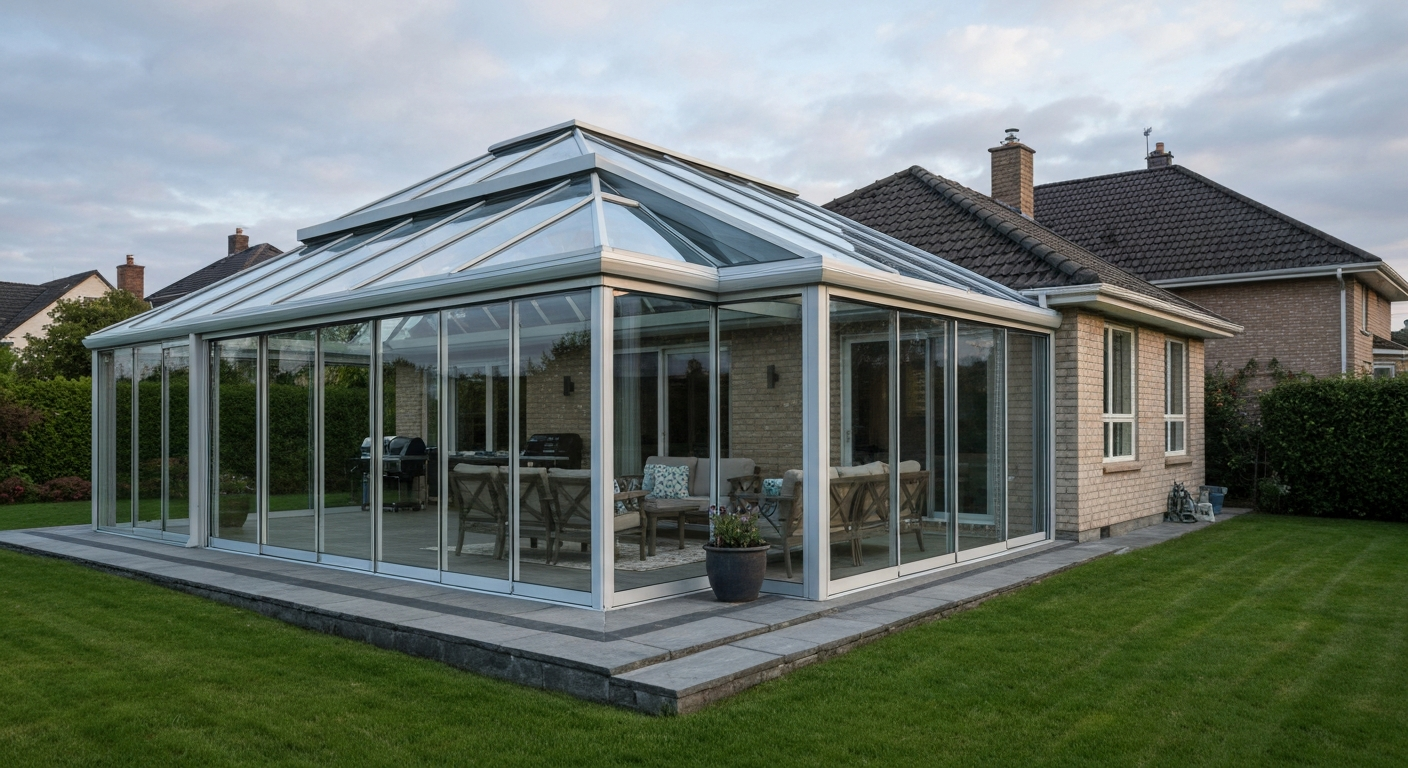
A sunroom is a fully enclosed, usually four-season addition with a glass or polycarbonate roof and glass walls, often tied into the home's HVAC or a separate mini-split system. A solarium typically refers to an all-glass roof design, maximizing light but also solar heat gain in summer. Manufacturers like Four Seasons Sunrooms publish detailed warranty documentation (available on their websites) and installation tolerances that installers are contractually required to follow. Reviews for sunroom projects are more complex than simpler enclosure reviews: they involve structural modifications, permits, and sometimes foundation work, so complaint themes in this category lean heavily toward timeline overruns and subcontractor coordination issues.
Pool enclosures
Glass or glazed panel pool enclosures extend the swimming season, reduce chemical evaporation, and provide safety barriers. They require specific permitting in most jurisdictions (pool barrier codes are enforced separately from general building permits in many states). Reviews for pool enclosure installers on Houzz and Google frequently mention measurement precision as a critical factor: poorly measured enclosures result in expensive rework, and this is one of the most common complaint themes in this segment. High-quality pool enclosures typically use aluminum framing with tempered safety glass and are designed to meet ASTM structural load standards for wind and snow where applicable.
Materials and performance: what actually separates good from cheap
Glass types
All glass used in structural patio applications should be tempered safety glass at minimum. Laminated glass (two layers bonded with an interlayer) offers additional safety and better sound attenuation. Insulated glass units (IGUs), which sandwich an argon- or krypton-filled gap between two panes, are necessary for conditioned sunrooms and provide measurably better thermal performance. NFRC-certified products carry independently verified U-factor (heat loss) and SHGC (solar heat gain) ratings. When a contractor or retailer cannot give you an NFRC label or data sheet, treat that as a gap in their product knowledge. Low-e coatings reduce UV transmission and heat gain without meaningfully reducing visible light transmission, and they're standard on any quality IGU intended for an enclosed, semi-conditioned space.
Framing systems
Aluminum is the dominant framing material for patio glass systems due to its corrosion resistance, strength-to-weight ratio, and availability in thermal-break configurations. Thermal-break aluminum (where insulating material separates the inner and outer frame sections) significantly reduces condensation and heat transfer compared to standard aluminum, which conducts cold directly indoors. Steel framing is used in some high-end architectural installations but requires more maintenance to prevent rust. Vinyl framing (common in budget sunrooms) has a lower initial cost but can expand and contract with temperature changes in a way that stresses seals and hardware over time. AAMA publishes performance classification standards for fenestration products that are worth referencing when comparing bids.
Seals, hardware, and accessories
Silicone and EPDM rubber seals are the standard for waterproofing glass joints and track systems. Silicone is preferred at fixed glass-to-frame joints; EPDM gaskets are common at moving parts. Both degrade under sustained UV exposure and in very cold climates, typically requiring inspection every 2–3 years and potential replacement every 7–12 years depending on climate zone. Hardware quality (hinges, handles, locks, rollers) is where budget enclosures often cut corners most visibly in long-term reviews. Marine-grade stainless steel hardware is worth specifying in coastal environments. For accessory components purchased separately (screens, shade systems, planters), verified-purchase Amazon reviews are a practical source of durability feedback for individual items.
Brand and retailer notes
We track reviews across several categories of businesses that overlap with garden glass patio searches. Here's how the main ones break down based on our aggregated data.
Greenway and similar regional enclosure companies
Greenway is one of the regional names that appears across our review database for patio and outdoor enclosure work. Reviews aggregated from Google and Houzz for Greenway-branded or Greenway-affiliated businesses tend to cluster around three-season enclosures and screen/glass hybrid systems. Positive reviews emphasize responsive sales staff and clean installation. Negative reviews, when they appear, most frequently cite communication gaps after the deposit is paid and scheduling delays during peak season (spring/summer). If you're researching Greenway specifically, our detailed Greenway patio reviews section covers rating breakdowns and recent complaint trends.
Garden and patio retailers
General garden and patio retailers, including big-box stores and specialty outdoor living shops, sell prefabricated glass panel kits, frameless balustrade systems, and sunroom add-on components. Manufacturer pages like blank" rel="noopener noreferrer">Porch Enclosures: Indoor-Outdoor Living | Eze-Breeze describe modular porch and patio enclosure systems and typical installation options, which is useful for distinguishing vinyl/plastic-panel systems from all-glass systems. Reviews for these retailers on Google and Yelp differ from installer reviews: the most common complaints are about product packaging damage during shipping, incomplete hardware kits, and limited installation support for DIY buyers. If you're comparing retailers in this category, our broader garden and patio reviews section aggregates those ratings across North America.
Garden-gate and patio-home installers
Some installers and developers market specifically to patio home communities and garden-gate style developments, where glass enclosures are added to attached or semi-attached patios in HOA-governed settings. These projects carry additional complexity because HOA approval runs parallel to municipal permitting. Reviews for these types of projects frequently surface HOA-related delays as a complaint even when the installer performed well. Our garden gate patio homes reviews section documents those specific dynamics if you're in a patio-home community.
Accessory vendors including VegTrug
Brands like VegTrug operate in the adjacent garden accessory space, supplying raised planters and garden furniture that often accompany glass patio setups. While VegTrug isn't a glass patio manufacturer, it shows up in searches because homeowners outfit their new glass patios with garden accessories in the same purchase cycle. Reviews for VegTrug and similar vendors are product-quality focused rather than installation-focused, and they're useful for assessing durability and value in the accessory layer of your outdoor space. For a deeper look, our VegTrug patio garden reviews section covers the most recent customer feedback.
How we collect, aggregate, and score reviews
Our methodology is worth explaining in detail because transparency in review aggregation is how you know whether to trust a rating. We pull from six primary sources: Google Business Profile reviews (public, timestamped, star-rated), Yelp (with awareness that Yelp's filtering algorithm excludes some reviews from its official rating, which we document), Houzz project pages (which are tied to specific completed projects and include photo documentation), Angi/HomeAdvisor (where we note that the platform's lead-generation model can create selection bias toward businesses that purchase leads), BBB complaint records (specifically for warranty and contract dispute patterns), and Amazon verified-purchase reviews for accessory-level products.
We do not include reviews we cannot timestamp or verify as tied to a specific business or product. When a platform like Yelp filters a review as 'not recommended,' we still log its existence and content but exclude it from our numeric score while noting the volume of filtered reviews as context. For each business, we compute a weighted composite score that gives more weight to recent reviews (within 18 months), verified-purchase or photo-documented reviews, and reviews with substantive text describing a specific project. A business with 200 reviews averaging 4.6 stars tells a different story than one with 12 reviews averaging 4.6 stars, and our display makes that volume distinction explicit.
We also cross-reference BBB complaint records and, where available, CPSC recall databases for any product safety notices affecting specific glazing components or prefabricated enclosure hardware. Public court records (via PACER for federal filings and state court docket tools for civil cases) are checked periodically for businesses with high complaint volumes to surface any pattern of unresolved contractor disputes.
How to read review scores and summaries
A star rating alone is not enough to make a hiring decision. Here's what the numbers and patterns actually tell you.
- Volume matters: A 4.8-star average from 15 reviews is less reliable than a 4.5-star average from 180 reviews. Smaller samples are more vulnerable to fake positives and are less statistically stable.
- Recency matters: A business with a strong 5-year average but a cluster of 2- and 3-star reviews in the past 12 months may have changed ownership, lost key staff, or scaled beyond its capacity.
- Response behavior matters: Businesses that respond to negative reviews with specific, solution-oriented replies demonstrate accountability. Businesses that respond defensively or not at all to 1-star complaints are showing you how disputes will be handled.
- Review velocity matters: A sudden spike of 5-star reviews within a short window is a pattern associated with solicited or incentivized reviews, not organic customer experience. We flag this in our scoring.
- Specificity matters: Reviews that describe a specific project detail (measurements taken, installation duration, crew behavior, product model) are more credible than generic praise or generic complaints.
- Platform context matters: Yelp's filtered reviews should not be ignored entirely. A business with 40 recommended reviews at 4.7 stars and 30 filtered reviews mostly at 1–2 stars warrants closer inspection than the headline rating suggests.
Top-rated companies: what the data actually shows
What 'top-rated' really means here
There is no single national top-rated glass patio company in the same way there is for, say, a consumer product sold everywhere identically. Glass patio installation is inherently local: crews, subcontractors, permit familiarity, and material sourcing all vary by market. A company that earns consistently strong reviews in Phoenix may have no presence in Minneapolis, and vice versa. When we designate a business as top-rated in our directory, it means: a composite score of 4.3 or above, minimum 30 scored reviews from the past 24 months, no unresolved BBB complaints in the past 12 months, and no CPSC-related recall flags on their primary product lines. Regional top-rated designations are applied by metropolitan area or state, not nationally, because that's the level at which the data is meaningful.
Common complaint themes across providers
Across the review data we've aggregated for glass patio installers and retailers, four complaint categories surface repeatedly regardless of brand or region.
- Installation quality and finishing: misaligned panels, gaps at seals, hardware that doesn't seat properly, and visible caulk work that looks unprofessional. This is the single most common complaint category and usually reflects rushed installation or inadequate crew training.
- Product fit and measurement errors: enclosures that don't fit the as-built space correctly, requiring rework or leaving aesthetic gaps. This happens most often when measurements are taken by a salesperson rather than a dedicated installation crew.
- Post-sale service and communication: difficulty reaching a company after payment is made, especially for warranty service calls. Reviewers frequently describe the pre-sale experience as excellent and the post-sale experience as unresponsive.
- Warranty disputes: disagreements over whether a defect is covered under the manufacturer's product warranty versus the installer's labor warranty, or claims that a problem resulted from 'owner misuse.' Clear, written warranty terms from both the manufacturer and installer are your primary protection here.
Realistic cost ranges and project timelines
These ranges are based on RSMeans cost data benchmarks, contractor quotes documented in our review database, and homeowner-reported project totals from 2024–2026. Costs vary meaningfully by region: labor rates in California and the Northeast can run 25–40% above the national midpoint, while parts of the South and Midwest run below it. All ranges below are for installed, permitted projects in a mid-cost North American market.
| Product Type | Typical Installed Cost Range | Typical Project Timeline | Key Cost Drivers |
|---|---|---|---|
| Frameless glass panel system | $5,000 – $15,000 | 1–3 days installation | Linear footage, glass thickness, hardware grade |
| Sliding/folding glass wall | $10,000 – $35,000 | 2–5 days installation | Number of panels, framing type, thermal break spec |
| Three-season patio enclosure | $8,000 – $25,000 | 3–7 days installation | Size, roof type, existing structure condition |
| Four-season sunroom (non-conditioned) | $25,000 – $55,000 | 2–6 weeks total | Foundation needs, framing complexity, glazing grade |
| Solarium (all-glass roof) | $40,000 – $80,000+ | 4–10 weeks total | Structural engineering, custom fabrication, HVAC tie-in |
| Pool enclosure (glazed panels) | $15,000 – $55,000 | 1–3 weeks total | Pool perimeter size, height, permit complexity |
Timeline figures represent the installation phase only. From signed contract to start of installation, lead times of 6–16 weeks are common for custom or semi-custom enclosures, driven by fabrication time and permit processing. Permit review alone can take 2–8 weeks depending on jurisdiction, and some municipalities require engineer-stamped drawings, which adds another 1–3 weeks and $500–$2,500 in engineering fees. If a contractor promises a very fast turnaround on a custom enclosure, ask specifically how they're achieving it, because short-cutting the permit process is a real risk in this industry.
Warranty, service, and maintenance expectations
What typical coverage looks like
Product warranties from manufacturers like Four Seasons Sunrooms cover glazing unit seal failure, framing finish, and structural components separately, often with different coverage periods (for example, 20 years on IGU seal failure, 10 years on framing finish, 5 years on hardware). Labor warranties from installers are typically 1–3 years and cover defects in installation workmanship, not product failures. This gap matters: if your sliding door track binds at year 4 due to a framing alignment issue from installation, neither warranty may clearly cover it. Always ask the installer to specify in writing what their labor warranty covers and what constitutes a warranty exclusion.
Common warranty exclusions
- Damage from 'acts of God' including hail, hurricane-force wind, or earthquake (even when the product is rated for those conditions, damage claims often default to homeowner insurance rather than product warranty)
- Seal or gasket degradation attributed to improper cleaning products (solvent-based cleaners void most EPDM and silicone gasket warranties)
- Hardware wear attributed to 'normal use' versus manufacturing defect (the line between these is often contested in BBB complaints)
- Damage resulting from homeowner modifications or attachments to the enclosure structure
- Condensation between IGU panes before the specified IGU seal warranty period has elapsed (sometimes excluded if the manufacturer attributes it to installation error rather than product defect)
Routine maintenance schedule
- Clean glass with mild soap and water or a pH-neutral glass cleaner twice per year minimum; avoid ammonia- and solvent-based products near seals and gaskets
- Inspect and lubricate track systems and hardware (hinges, rollers, locks) annually with a manufacturer-recommended lubricant (typically silicone spray, not petroleum-based products)
- Inspect all perimeter seals and caulk joints annually; replace any cracked, shrunken, or separating sealant before water infiltration occurs
- Clear drainage channels and weep holes in track systems seasonally, especially in fall before freeze-thaw cycles begin
- Check glazing panel retention and edge bite (the depth the glass sits in its frame) every 2–3 years; panels that have shifted can compromise safety and weathertightness
- Have a qualified contractor inspect the attachment points between the enclosure and the main structure every 5 years
Regional permitting, HOA rules, and building codes
Permits are required for virtually every enclosed patio addition in North America. The International Building Code (IBC) and International Residential Code (IRC), published by the ICC, are the model codes that most jurisdictions adopt (with local amendments). That means your local building department's specific requirements can differ from what you read on a manufacturer's website or a national contractor's FAQ. The only reliable source for what your jurisdiction requires is your local building or planning department.
Common regional considerations include: setback requirements (how close an enclosed structure can be to property lines, which varies by zoning district), impervious surface limits (some municipalities cap the percentage of a lot that can be covered by structures or hardscape, and a glass patio counts), energy code compliance (some states have adopted their own energy codes that exceed the baseline IRC, affecting glazing U-factor requirements for enclosed spaces), and seismic or wind load requirements in California, Florida, and coastal states that require engineer-stamped drawings for any new enclosure.
If you live in an HOA-governed community, add an HOA approval step before applying for a building permit. HOA architectural review committees often have aesthetic restrictions (framing color, glass tint, visibility from the street) that can result in redesign costs if not addressed early. Some HOAs specifically prohibit enclosures that change a home's roofline. Get HOA approval in writing before any money changes hands with a contractor.
Red flags to watch for in reviews and during the sales process
Red flags in online reviews
- A cluster of 5-star reviews posted within a short window (1–2 weeks), especially from reviewer accounts with no other review history on the platform
- Generic praise with no project-specific detail: 'Amazing company, highly recommend!' with no mention of what was installed, when, or how
- Responses to negative reviews that deny the customer was ever a client or shift blame entirely to the homeowner without acknowledging any responsibility
- BBB complaint entries where the business response is a form letter rather than a specific resolution description
- A significant gap between the Yelp recommended rating and the raw (including filtered) review set, particularly if the filtered reviews are more recent and more negative than the recommended ones
- No negative reviews at all over a multi-year period for a business with significant project volume; this is statistically unusual and often reflects aggressive review removal requests or a non-organic review profile
Red flags during the sales process
- Verbal pricing only, with no itemized written quote specifying materials, glass specs, framing type, and labor scope
- High-pressure deposit requests before a site measurement has been completed
- Requests for more than 33–40% of the total project cost as an upfront deposit (reasonable deposits are typically 25–33%)
- A salesperson who cannot name the specific glass product, its U-factor, or its safety glazing certification
- Contractors who suggest skipping the permit 'to save time and money' — this creates liability for you, not them, and can invalidate your homeowner's insurance for the project
- Bait-and-switch pricing: a low initial quote that grows materially at the measurement appointment or shortly after signing, citing 'site conditions' that any experienced contractor should have anticipated
- No verifiable local references for projects similar in scope to yours
How to vet an installer or retailer before you commit
Checking a contractor's credentials takes about an hour and can save you significant money and stress. Here's the practical process.
- Verify their contractor's license with your state licensing board. Most states have a free online lookup. Confirm the license is active, in the correct trade category (home improvement, general contractor, or specialty glazing depending on your state), and held by the actual business entity you're contracting with, not a related but different company name.
- Request a certificate of insurance showing general liability (minimum $1 million per occurrence is a reasonable benchmark for residential projects) and workers' compensation. Ask to be named as an additional insured on the liability policy for the project duration.
- Check their BBB profile for complaint history and resolution patterns. Look at the nature of complaints, not just the volume: warranty disputes and unresolved billing issues are more concerning than scheduling complaints.
- Ask for three recent local references for projects of similar size and product type. Call them. Ask specifically about post-installation service: did any issues come up after installation, and how were they handled?
- Ask whether they have a showroom, demo unit, or past project you can visit in person. Seeing finished work in person reveals fit-and-finish quality that photos cannot.
- Search for the business name plus 'lawsuit' or 'court' in your state's public court docket search tool. Isolated disputes are not necessarily disqualifying, but a pattern of contractor litigation is.
- Confirm they will pull permits and handle all required inspections. If they say permits aren't needed for your project, verify that independently with your building department before accepting it.
Buyer checklist before you sign
- Measurements confirmed by installation crew (not salesperson only), with as-built drawings or a dimensioned sketch attached to the contract
- Product specifications in writing: glass type, thickness, safety glazing certification, IGU U-factor and SHGC if applicable, framing material and finish, hardware grade and brand
- Itemized cost breakdown separating materials, labor, permit fees, and any engineering or design fees
- Change order policy in writing: what triggers a change order, who authorizes it, and the maximum cost variance allowed before your written approval is required
- Payment milestone schedule tied to project phases (for example: 25% at signing, 25% at permit approval, 25% at installation start, 25% at completion and final inspection)
- Permit responsibility clearly assigned to the contractor, with a timeline for permit application
- Manufacturer product warranty documentation (actual document, not a summary) with warranty registration process confirmed
- Installer labor warranty in writing, with specific coverage scope, exclusions, and the claims process
- HOA approval letter in hand if applicable, before signing the contract
- Completion date and a clear definition of 'substantial completion,' including who conducts the final walkthrough and what constitutes an acceptable punchlist item versus a warranty item
- Dispute resolution clause: does the contract specify mediation, arbitration, or litigation? In which jurisdiction?
Questions to ask contractors and retailers
These are the specific questions that distinguish contractors who know their product from those who don't. Vague or deflecting answers to technical questions are meaningful data points.
- What is the specific glass product you're proposing, and can you provide the NFRC label or data sheet showing U-factor and SHGC?
- Is the glass tempered, laminated, or an IGU? What thickness? Does it meet ASTM E1300 design load requirements for my climate zone?
- What framing material are you using, and is the aluminum thermally broken? What finish warranty comes with it?
- Who will be pulling the permits, and how long has that typically taken in my municipality recently?
- Will a single crew do the entire installation, or are there subcontractors? If subcontractors, who are they and what is their installation experience with this product?
- What is your labor warranty, and what exactly does it cover? Can you give me two examples of warranty service calls you've handled in the past year?
- What is your typical lead time from signed contract to installation start for a project like mine?
- What happens if a panel is damaged during installation — is that covered under your insurance, or will I be asked to cover a material upgrade cost?
- Who do I call after installation if I have a problem, and what is your average response time for service calls?
- Has this specific product been installed in my climate zone, and are there any known performance considerations I should be aware of?
What to expect on installation day
A professional installation crew should arrive with the materials pre-cut or pre-fabricated to your site measurements, confirmed permit in hand or permit placard posted, and a clear daily work plan. For a frameless panel system, most single-day installations can realistically be completed in one day with a two-person crew. For sliding wall systems or three-season enclosures, expect 2–5 days with some days involving early-morning starts before weather gets hot.
On installation day itself: clear the work area before the crew arrives, including removing patio furniture, planters, and any obstacles within 3–4 feet of the work zone. Protect interior flooring if crews will be moving through the house. Ask the crew lead at the start of the day what the day's scope is and what will and won't be completed. At the end of each day, walk the work with the crew lead and note any concerns in writing (text message records are useful documentation).
Post-installation checks to do before the crew leaves
- Open and close every operable panel, door, and window through its full range of motion. Hardware should operate smoothly without force.
- Check all glass panels for chips, scratches, or stress cracks, which should be documented and addressed before final payment
- Run a hose test on the perimeter seals and track systems if weather permits — spray water along top rails and perimeter seals to confirm no active leaks
- Confirm all drainage channels and weep holes are clear and functional
- Walk the attachment points where the enclosure meets the home structure and look for gaps, misalignment, or sealant voids
- Request copies of the inspector's sign-off or the permit final approval before making the final payment if your jurisdiction requires a final inspection
Financing, insurance, and home value
Glass patio enclosures are typically financed through home equity lines of credit (HELOCs), personal loans, or contractor-arranged financing programs. HELOCs generally offer the lowest interest rates for homeowners with sufficient equity, and the interest may be tax-deductible if the loan qualifies as home acquisition debt, though you should confirm current deductibility rules with a tax advisor. Contractor financing programs are convenient but often carry higher effective rates embedded in promotional terms; read the fine print on deferred-interest offers carefully.
From a homeowner's insurance perspective, a permitted, inspected glass patio enclosure becomes part of your home's dwelling coverage once it's attached to the structure. Notify your insurer when the project is complete and provide the final permit approval, because undisclosed additions can create coverage gaps. In hurricane- and hail-prone regions, ask your insurer specifically how a glass enclosure affects your wind and hail deductibles, since these are sometimes calculated separately from your standard deductible.
On home value: a well-executed, permitted glass enclosure adds functional living space that appraisers can recognize, but the value attribution varies significantly by market. In markets where three- or four-season outdoor living is a buyer priority (Sunbelt, Pacific Northwest, parts of the Midwest), a high-quality enclosure can return 50–70% of its cost at resale according to Remodeling Magazine's cost-vs-value data, though the range varies. An unpermitted or low-quality enclosure can actually reduce buyer appeal and create disclosure obligations at resale.
Your step-by-step path from research to maintenance
- Define your goals and constraints: What season extension do you need? What is your hard budget ceiling? Does your HOA have restrictions? Write these down before talking to anyone.
- Research product types: Use this guide's enclosure type section and browse completed project photos on Houzz to identify which system (frameless, sliding, sunroom, pool enclosure) fits your space and usage.
- Check regional requirements: Call or visit your local building department to confirm permit requirements, setbacks, and any energy code glazing specs before you start getting quotes.
- Get HOA pre-approval if applicable: Submit a preliminary design concept to your HOA architectural committee before investing time in formal quotes.
- Search and shortlist contractors: Use our review directory to identify top-rated businesses in your metro area. Aim for three candidates with strong review scores (minimum 4.3 stars, 30+ recent reviews, clean BBB history).
- Request itemized quotes: Ask each contractor for a written, itemized quote specifying all materials and specs. Give each bidder the same project brief so quotes are comparable.
- Verify licenses and insurance: Run license checks and request insurance certificates from all finalists.
- Check references and see finished work: Call at least two references per contractor. Visit a completed project in person if possible.
- Negotiate and sign a complete contract: Use the buyer checklist in this guide. Do not sign without all specifications, payment milestones, change order policy, and warranty terms documented.
- Register your product warranty: Do this immediately after installation. Manufacturer warranties often require registration within 30–90 days of installation.
- Set up your maintenance plan: Use the maintenance schedule in this guide. Calendar your annual hardware lubrication, seal inspection, and drainage clearance tasks.
- Leave a verified review: After living with your enclosure through a full seasonal cycle, share your experience on Google, Yelp, or Houzz. Detailed, specific reviews are what help other homeowners make better decisions.
FAQ
Which authoritative data sources should I consult to produce an accurate review-and-buying guide for garden glass patios?
Use a mix of public-review platforms (Google Business Profile, Yelp, Houzz, Angi), retailer/product marketplaces (Amazon), business/complaint registries (BBB), manufacturer primary sources (product specs, installation manuals, warranties from brands like Solarlux and Four Seasons), regulatory and standards bodies (ICC/IBC & IRC, NFRC, AAMA, ASTM), safety/recall databases (CPSC/recalls.gov), legal records (PACER and state court dockets), and cost-estimating references (RSMeans/Gordian). Cross-reference platform reviews with complaint records, manufacturer docs, and building-code/standards citations to validate claims.
What specific review-platform data fields must be collected and normalized when aggregating customer feedback?
Collect star rating, review text, review date, reviewer location (when available), verified-purchase or service indicators, photos, business response text, and metadata (e.g., Yelp’s recommended/not-recommended flag). Normalize dates to a common format, map reviewer locations to regions, flag repeat reviewers, record whether a review references product, installer, or retailer, and capture complaint resolution status (from BBB or business replies).
Which manufacturer and product documents are essential to verify technical claims and warranty terms?
Download product specifications, NFRC labels (U-factor, SHGC, VT), installation manuals, engineering/design load tables (glass thickness, framing spans), explicit written warranty documents (coverage period, exclusions, transferability), and any published installation tolerances or maintenance instructions from the manufacturer website or authorized distributor.
What regulatory and standards references must be checked for safety, performance and permitting guidance?
Reference the International Building Code (IBC) and International Residential Code (IRC) and local amendments for enclosure classification and structural requirements; NFRC certification for energy ratings; AAMA installation/performance guidelines; ASTM glazing standards (e.g., E1300) for glass design and impact testing; and local municipal permitting rules. Use CPSC recall database to check for component recalls.
How should I evaluate and score installers and retailers using aggregated review data?
Combine quantitative metrics (average star rating, review volume, recent-12-month trend, complaint ratio vs. peer set) with qualitative signals (recurring themes in service/quality, response behavior to complaints, photo-documented project quality). Weight recent, verified-purchase/service reviews and unresolved BBB/ court complaints more heavily. Convert to a composite score with transparent weighting (e.g., 40% recent rating, 25% complaint history, 20% resolution behavior, 15% documented project quality).
What research questions identify top-rated companies and common complaint themes?
Which companies have the highest composite scores and sustained review volume? What recurring positives (communication, adherence to schedule, craft/finish, warranty service) appear? What recurring negatives (missed timelines, hidden change orders, poor sealing/water intrusion, defective hardware, warranty denial, unlicensed subcontracting) appear? Are complaints clustered by region, product type, or installer? How often do companies resolve complaints and how quickly?
Next Article
Garden and Patio Reviews: How to Compare Sellers & Installers
Garden and patio reviews: compare products, installers, enclosures, and retailers to hire or buy confidently.