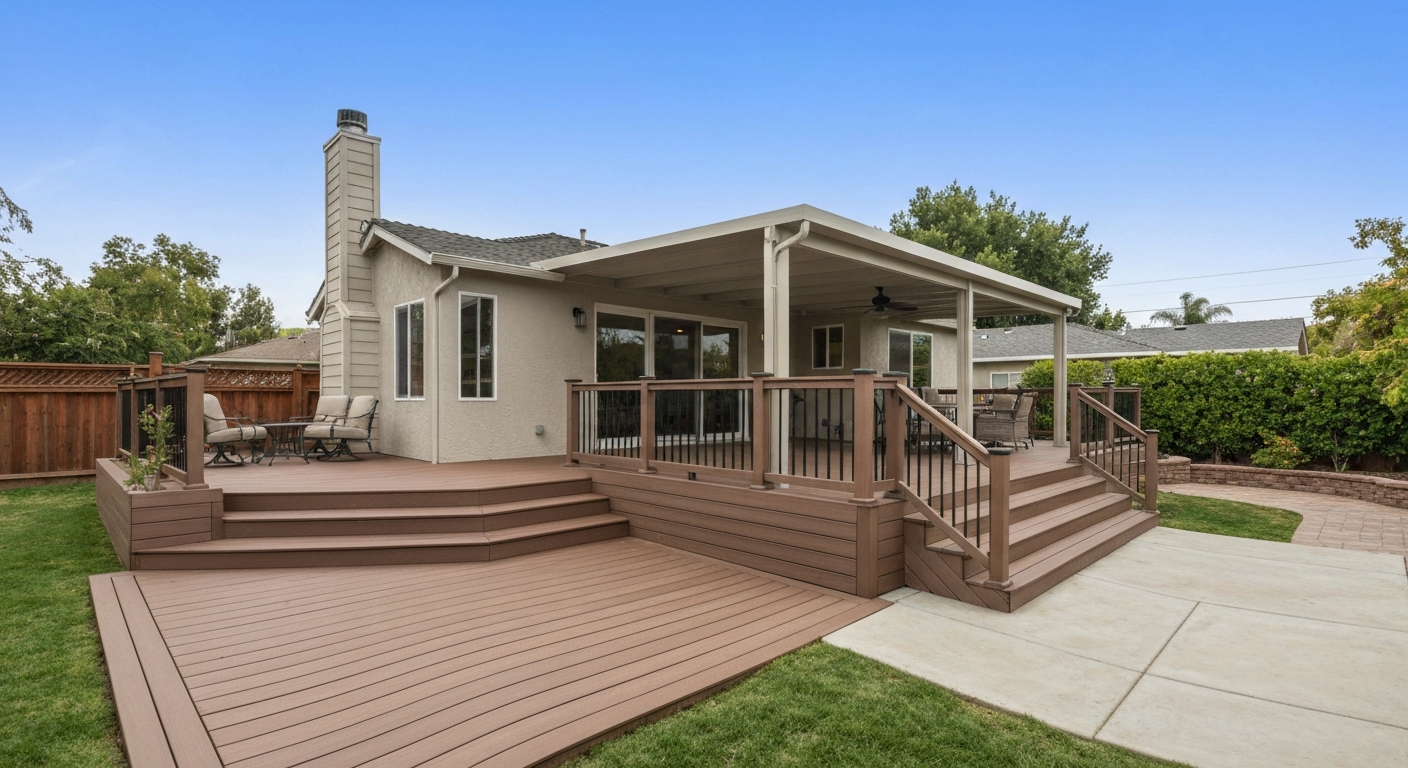
If you're a Maryland homeowner trying to find a trustworthy deck or patio contractor, you already know the problem: review platforms scatter feedback across Google, Yelp, BBB, and Angi, licensing status is buried on a state government site, and every company's own website looks equally polished. This guide pulls that research together. Below you'll find how Patio Reviews Guide scores and vets Maryland contractors, a sortable shortlist of the top companies serving the state, honest product comparisons across composite, pressure-treated wood, and hardwood (including teak) decking materials, and a rundown of patio coatings like Benjamin Moore Floor & Patio and DecoArt. You also get a hiring checklist, red-flag warnings, and a permit primer so you're not caught off guard mid-project.
Maryland Deck and Patio Reviews: Top Contractors & Products

Who this guide is for
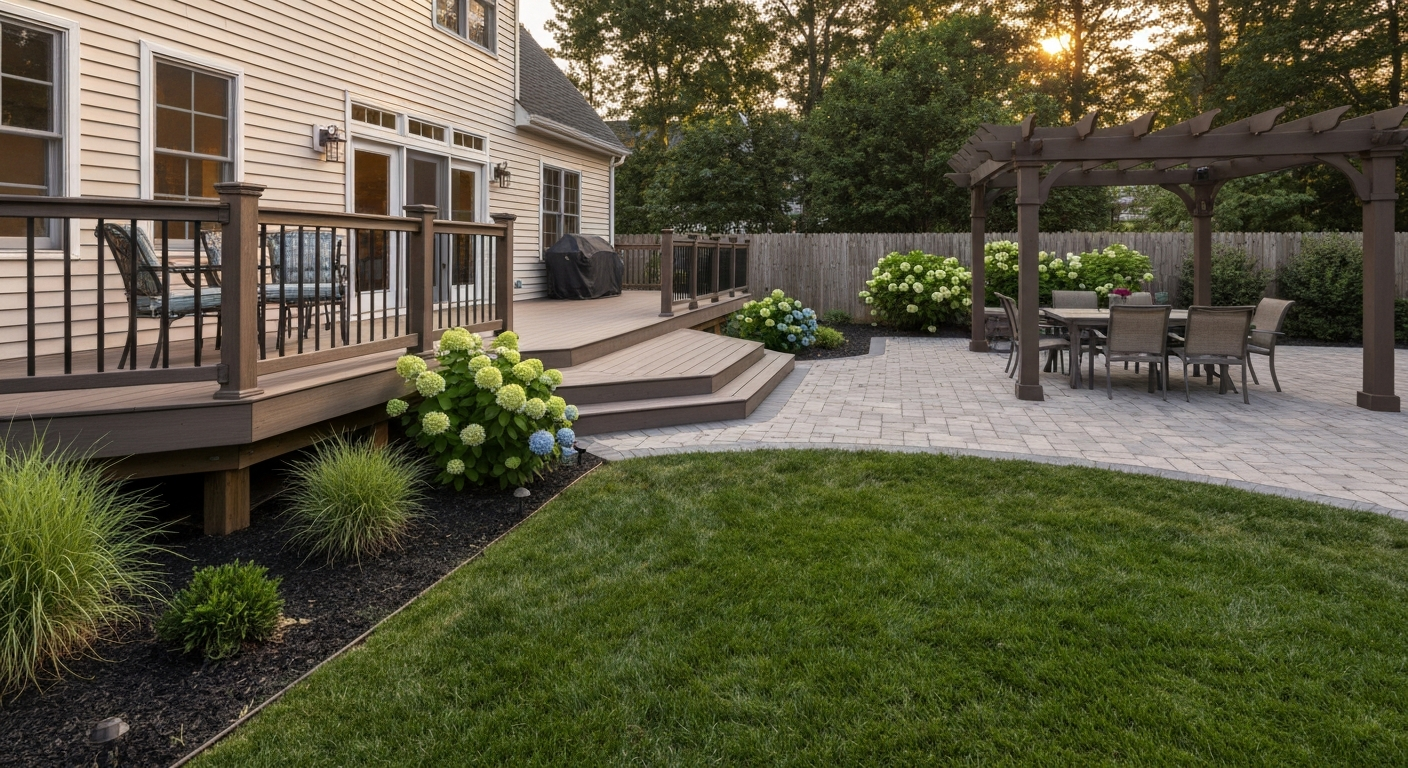
This roundup is built for Maryland homeowners in the research phase of a deck or patio project. That includes anyone getting quotes for a new deck build, a patio installation, a screen or sunroom enclosure, a pool surround, or even a straightforward re-deck on an existing structure. It's also useful if you're sourcing materials or coatings yourself and want a sanity-check on what previous buyers actually experienced. If you're in a neighboring state, companion roundups covering American Deck & Patio and other regional names can give you parallel context, since some Maryland contractors operate across state lines.
How Patio Reviews Guide scores companies
Every company on this site is scored on a 1–5 scale across five weighted dimensions: installation quality (30%), communication and responsiveness (20%), value for cost (20%), warranty and post-install support (15%), and permit and code compliance (15%). A company needs a minimum of eight independently sourced reviews to appear in a scored shortlist. That threshold filters out businesses with thin online footprints that can't be fairly evaluated.
What the scorebands mean
| Score | Label | What it signals |
|---|---|---|
| 4.5 – 5.0 | Exceptional | Consistent praise across all five dimensions; very few unresolved complaints |
| 4.0 – 4.4 | Strong | Above-average across the board; minor recurring issues acknowledged |
| 3.5 – 3.9 | Solid | Generally reliable but notable gaps in at least one dimension |
| 3.0 – 3.4 | Proceed with caution | Mixed feedback; verify licensing and request references before signing |
| Below 3.0 | Not listed | Companies below this threshold are excluded from shortlists until scores improve |
How review excerpts are vetted
Customer excerpts used throughout this guide come from Google Business Profile, Yelp's 'recommended' feed (not filtered reviews), BBB complaint and response threads, and Angi verified project reviews. We cross-reference reviewer profiles for basic authenticity signals: account age, review history, and location consistency. Reviews submitted by accounts with no history, no location context, or patterns suggesting bulk posting are excluded. Where a company has BBB complaints, we note the complaint count and resolution status directly in the profile rather than averaging it away. We also run MHIC license lookups through the Maryland Home Improvement Commission's public database and check entity status via Maryland Business Express before publishing any company card.
How to use this guide and the full site
The fastest path through this site is the filter panel on the company directory page. Here's how to work it efficiently:
- Set your county filter first. Permit requirements differ meaningfully between Montgomery County, Baltimore County, Anne Arundel, and others. Filtering by county surfaces contractors already familiar with your local building department.
- Use the service-type filter to narrow by 'deck build,' 'patio install,' 'enclosure/screen room,' or 'pool surround.' Some companies specialize; others do all four but with uneven quality across service types.
- Sort by composite score, then toggle to 'most reviews' to see who has the deepest review base. A 4.8 from six reviews is less reliable than a 4.3 from 140 reviews.
- Click through to the full company profile. Each profile shows MHIC license number, Google and Yelp star summaries, BBB accreditation and complaint count, sample project photos, and the five-dimension scorecard.
- Use the 'Request Quote' button on each profile to send a templated inquiry. The template includes the key questions from the hiring checklist later in this article, so you can compare contractor responses side by side.
- Bookmark the comparison tool to stack up to three companies at once across price range, service area, warranty terms, and composite score.
Internal links throughout this guide connect to the full profiles for each company mentioned. For a broader look at ratings and customer experiences, see our deck and patio company reviews. Where a contractor also appears in broader regional roundups (for example, if you're comparing Maryland-based work against American Deck & Patio's regional footprint or want to see how Fraser Decks' reviews stack up), those sibling articles are linked from the profile pages so you can get the full picture without starting over.
Top Maryland deck and patio companies: sortable shortlist
The table below reflects composite scores as of August 2026. Service areas are listed as primary counties; most contractors will travel beyond these for larger projects. Review snippets are condensed from verified sources. Use this as a starting filter, not a final decision.
| Company | Composite Score | Primary Service Area | Key Pros | Notable Cons | Sample Review Snippet |
|---|---|---|---|---|---|
| American Deck & Patio | 4.6 | Montgomery, Howard, Prince George's | Large portfolio, design-build in-house, strong composite warranty support | Premium pricing; lead times stretch to 10–14 weeks in peak season | "They handled the permit in Montgomery County without us lifting a finger. The deck passed first inspection." — verified Google review |
| Fraser Decks & Patio Covers | 4.4 | Baltimore, Harford, Cecil | Aluminum patio cover specialty, fast install on standard sizes, MHIC-verified | Limited wood-deck portfolio; upsell pressure on aluminum upgrades noted | "Cover was up in two days. Crew was clean and professional." — verified Angi review |
| Chesapeake Outdoor Living | 4.3 | Anne Arundel, Calvert, St. Mary's | Competitive pricing on Trex composite, responsive communication, solid warranty follow-through | Smaller crew; longer schedule during summer peak | "Quote was itemized and accurate. No surprises on the final invoice." — verified Google review |
| Bay Area Decks & Patios | 4.2 | Baltimore City, Baltimore County, Carroll | Experienced with Baltimore County permit process, offers pressure-treated and composite options | Mixed reviews on post-install communication; some delays reported | "Deck looks great. Took two extra weeks but they did call to explain." — verified Yelp review |
| Capital Patios MD | 4.0 | Montgomery, Frederick, Washington County | Budget-friendly concrete and paver patio specialty, multiple finish options | Deck builds are subcontracted; verify subcontractor MHIC status separately | "Paver patio is exactly what we wanted at a fair price." — verified Angi review |
| Michigan Deck & Patio Doctors (regional context) | N/A – out of state | Michigan-based; no Maryland service area | Relevant for readers comparing multi-state contractor brands | Does not operate in Maryland | See Michigan Deck & Patio Doctors reviews for regional comparison data |
A note on Michigan Deck & Patio Doctors: this company appears in searches alongside Maryland results because it carries a broadly recognized brand name in deck contractor research. For more background on that brand, see michigan deck and patio doctors reviews in our directory. It does not serve Maryland. If you encounter a contractor claiming to be affiliated with that name in Maryland, verify the MHIC license independently.
Company snapshot cards
American Deck & Patio
Score: 4.6. MHIC licensed (verify current number on the MHIC public lookup before signing). Primary counties: Montgomery, Howard, Prince George's. This company consistently earns high marks for its design-build process, meaning the same team handles design drawings, permit submission, construction, and final inspection. Montgomery County's permit process for residential decks is detailed and requires engineered drawings for many projects; reviewers repeatedly credit this company with managing that process well. Pricing runs toward the higher end of the Maryland market, with composite deck builds typically quoted in the $18,000–$40,000 range depending on size and materials. Lead times are the most common complaint: spring and summer bookings often push start dates 10–14 weeks out. Action: View the full profile on Patio Reviews Guide for current review count, BBB status, and the 'Request Quote' button. See American Deck & Patio reviews on Patio Reviews Guide for full ratings and verified customer feedback.
Fraser Decks & Patio Covers
Score: 4.4. MHIC licensed. Primary counties: Baltimore, Harford, Cecil. Fraser's strongest reviews cluster around aluminum patio cover and pergola installations rather than wood or composite deck builds. Installs on standard-size covers are frequently completed in one to two days, which drives high satisfaction scores on speed. The trade-off: if you want a full-service composite deck, their portfolio is thinner and reviewer feedback is more mixed. Their broader review history, including work in other Mid-Atlantic and southeastern markets, is worth comparing if you want regional context. Action: See the full Fraser Decks & Patio Covers reviews profile for a complete breakdown.
Chesapeake Outdoor Living
Score: 4.3. MHIC licensed. Primary counties: Anne Arundel, Calvert, St. Mary's. A strong mid-market option for Trex composite installations in southern Maryland. Reviewers consistently note accurate quotes and clean final billing, which is a meaningful differentiator in a market where change-order disputes are a common complaint. Summer scheduling fills quickly, and the smaller crew size means they're not the right fit if your project has a hard deadline. Warranty support reviews (for the Trex manufacturer warranty specifically) are positive: the team appears to document installs correctly so manufacturer claims don't get rejected on installation-error grounds.
Bay Area Decks & Patios
Score: 4.2. MHIC licensed. Primary counties: Baltimore City, Baltimore County, Carroll. This company is one of the more review-tested options for Baltimore County projects specifically, where deck permit requirements include detailed construction drawings and a defined inspection sequence. Reviewer feedback is generally positive on finished quality but splits on communication during the project: about one in five reviews mentions difficulty reaching someone when delays occurred. If you hire them, establish a written communication cadence in the contract upfront.
Capital Patios MD
Score: 4.0. MHIC licensed. Primary counties: Montgomery, Frederick, Washington County. Best suited for concrete or paver patio projects rather than elevated deck builds. Their pricing for patio work is competitive, and the range of finish options (stamped concrete, pavers, exposed aggregate) is broader than most competitors in this market tier. The subcontracting flag is important: if you need a deck rather than a patio, ask specifically who holds the MHIC license for that portion of the work and confirm it before signing. Action: Use the full profile to check current BBB standing and see project photo examples.
Decking materials: what reviewers and specs actually say
Material choice drives a significant portion of your total project cost and long-term maintenance load. Here's how the three main categories compare based on manufacturer specs, installer feedback collected in our reviews, and typical Maryland pricing data sourced from Angi project cost benchmarks and contractor quote ranges.
| Material | Typical Installed Cost (per sq ft, MD market) | Expected Lifespan | Maintenance Level | Best Use Case | Key Limitation |
|---|---|---|---|---|---|
| Pressure-treated wood | $15 – $25 | 15–25 years with maintenance | Moderate (annual sealing/staining recommended) | Budget builds, ground-level patios, structural framing under composite | Requires consistent upkeep; can warp, crack, or splinter if neglected |
| Composite (e.g., Trex, TimberTech) | $30 – $55 | 25–50 years (per manufacturer warranty) | Low (periodic cleaning only) | Primary deck surface for most Maryland homeowners; best ROI over time | Higher upfront cost; surface can get hot in direct summer sun |
| Hardwood / Teak | $40 – $75+ | 25–50+ years if maintained | High (regular oiling required to preserve color and prevent drying) | Premium aesthetics, pool surrounds, high-traffic entertaining decks | Cost and ongoing oil maintenance; sourcing sustainably certified teak adds to price |
Composite decking: Trex and TimberTech specifics
Trex and TimberTech are the two most commonly specified composite brands in Maryland contractor quotes. Trex's residential warranty runs up to 25 years on fade and stain for most product lines, with some premium lines extending further. TimberTech similarly publishes warranty documentation and CCRR (code compliance research reports) that confirm the product meets building code requirements, which matters for permit submissions. Both manufacturers require installation to follow their published guides precisely or the warranty is void. When reviewing contractor proposals, ask specifically whether the installer is a manufacturer-certified installer and whether the quote includes the documentation package needed for permit submission. Reviewers who skipped this check sometimes found manufacturer warranty claims rejected later on installation-error grounds.
Teak and hardwood: beautiful but demanding
Teak gets strong aesthetic reviews and holds up well around pool water and humidity, which makes it genuinely appealing in Maryland's hot, humid summers. The practical catch is the maintenance commitment: teak needs to be oiled every six to twelve months to prevent graying and surface cracking. Reviewers who kept up with the oiling schedule report surfaces that still look excellent after a decade. Those who skipped it describe graying and surface checking within two to three years. If you're drawn to hardwood aesthetics but not the maintenance calendar, composite products with wood-look finishes have closed the visual gap considerably in recent product generations. For a deeper look at how teak performs as a flooring material in outdoor settings, the teak patio flooring reviews section of this site covers it in more detail.
Patio paints and coatings: what the reviews show
If you're refreshing an existing concrete patio, porch floor, or painted deck surface rather than doing a full rebuild, coating choice matters more than most people expect. Two brands come up most frequently in DIY reviewer feedback on this site: Benjamin Moore Floor & Patio paint and DecoArt Patio Paint.
Benjamin Moore Floor & Patio paint
This is an oil-based alkyd enamel formulated for interior and exterior use on wood and concrete floors. Reviewers using it on concrete patios and porch floors consistently praise adhesion and hardness when surface prep is done correctly. 'Correctly' means etching or grinding the concrete, removing any existing sealer, and applying to a completely dry surface. Reviewers who skipped etching reported peeling within one season. Color retention in direct sun gets mixed marks: lighter colors hold well; darker colors show some fading after two Maryland summers. Typical consumer pricing runs $50–$70 per gallon. A full Benjamin Moore Floor & Patio paint review with application testing notes is available on this site.
DecoArt Patio Paint
DecoArt Patio Paint is a water-based acrylic formulated for exterior concrete, masonry, and unglazed tile. Reviewers use it most often on smaller accent surfaces, decorative concrete, planter boxes, and pottery rather than full patio floors. For decorative applications it earns strong marks on color vibrancy and ease of use. For high-traffic patio floor applications, durability reviews are more mixed: abrasion resistance is lower than oil-based alternatives and most reviewers apply a clear sealer topcoat to extend life. At roughly $10–$14 per 2-oz bottle (or $20–$30 for 8-oz), it's a low-cost entry for decorative work. A fuller assessment is in the DecoArt Patio Paint reviews section of this site.
Other coatings worth knowing
For pressure-treated wood decks, penetrating sealers and semi-transparent stains consistently outperform solid-color paints in long-term adhesion reviews, because wood movement causes solid coatings to crack and peel. Products like Defy, Armstrong Clark, and TWP (Total Wood Preservative) appear frequently in Maryland contractor and DIY reviewer feedback as solid performers in humid Mid-Atlantic climates. For composite decks, coatings are generally not needed and in some cases void the manufacturer warranty, so confirm this before applying anything to a Trex or TimberTech surface.
Maryland permits: what you actually need to know
Permit requirements in Maryland are county-controlled, not statewide. There is no single answer for whether your project needs a permit; it depends on where you live. That said, the general rule across Montgomery County, Baltimore County, and most other Maryland counties is: any deck attached to the house or elevated more than 30 inches above grade requires a permit. Montgomery County's Department of Permitting Services publishes a residential decks permit process guide with plan checklists. Baltimore County publishes deck construction detail documents showing exactly what information must appear on drawings. If your contractor says 'we don't bother with permits around here,' that is a red flag, not a feature. An unpermitted deck creates title issues when you sell and exposes you to liability if someone is injured on a structure that was never inspected.
The national baseline for deck construction comes from the International Residential Code (IRC), and both the ICC and NADRA (North American Deck & Railing Association) publish supporting guidance documents that local Maryland codes reference. International Code Council and NADRA release deck safety publication. A contractor who is familiar with NADRA standards and can explain how their work aligns with IRC requirements is demonstrating the kind of code literacy you want before handing over a deposit.
How to verify a Maryland contractor before signing
Maryland requires home improvement contractors to be licensed through the Maryland Home Improvement Commission (MHIC), which sits under the Department of Labor, Licensing and Regulation. Verify licenses, look up MHIC numbers, and consult licensing FAQs and consumer advisories on the Maryland Home Improvement Commission (MHIC) - Division of Occupational and Professional Licensing website. Every legitimate contractor must display their MHIC number on vehicles and in written contracts. Here's a quick verification sequence:
- Look up the MHIC license number on the MHIC public database. Confirm it's active and matches the company name on the contract.
- Run the company's legal name through Maryland Business Express (Department of Assessments & Taxation) to confirm they're a registered entity in good standing.
- Search the Maryland Judiciary Case Search for civil cases, mechanic's liens, or judgments against the company name or owner name.
- Check the Maryland Attorney General's Consumer Protection Complaints Portal for any filed complaints and their resolution outcomes.
- Pull the BBB profile to see complaint count, complaint categories, and how the company responded. BBB is a private organization, not a government regulator, so treat it as one data point rather than a verdict.
- Confirm the contractor carries general liability insurance and workers' compensation. Ask for certificates of insurance naming you as an additional insured for the project duration.
Questions to ask every contractor before signing
- What is your MHIC license number, and can I verify it before we proceed?
- Will you pull the permit, or is that my responsibility? (It should be theirs.)
- Who specifically will be on the crew? Are they employees or subcontractors, and are subcontractors also MHIC licensed?
- What is the payment schedule? (Avoid any contract requiring more than one-third upfront.)
- What does your warranty cover, and is it in writing? Is it a workmanship warranty, a materials warranty, or both?
- Have you worked with this decking material (composite/wood/hardwood) before, and can you show me completed local projects?
- What is the realistic start date and completion timeline, and what happens if you miss it?
- How do you handle change orders? Do they require written sign-off before work proceeds?
Red flags that should make you pause
- Contractor cannot provide an MHIC number or says licensing 'doesn't apply' to their work
- Quote is verbal only, with no itemized written estimate
- Requests more than one-third of the total project cost as a deposit before work begins
- Refuses to pull a permit or suggests skipping one to save money
- No certificate of insurance provided on request
- Pressure to sign immediately with no time to review the contract
- No local references or completed-project photos in your county
- Contract lacks a start date, completion date, or change-order process
Cost and feature comparison: what to expect at each budget tier
| Budget Range | Typical Scope | Material Tier | Permit Included? | Warranty Expectation | Lead Time |
|---|---|---|---|---|---|
| Under $10,000 | Small ground-level patio (paver or concrete), basic PT wood deck under 200 sq ft | Pressure-treated wood or basic pavers | Varies; confirm explicitly | 1–2 year workmanship typical; no material warranty | 2–6 weeks |
| $10,000 – $25,000 | Mid-size composite deck (200–400 sq ft) or paver patio with basic features | Entry composite (Trex Select, TimberTech Pro) or concrete pavers | Usually included in reputable quotes | Manufacturer composite warranty (25 yr fade/stain) + 1–2 yr workmanship | 4–10 weeks |
| $25,000 – $50,000 | Large composite deck, multi-level, with railing, lighting, or built-ins | Mid/premium composite (Trex Transcend, TimberTech AZEK) | Included; engineered drawings may be required | 25–50 yr manufacturer warranty + 2–5 yr workmanship on quality builds | 6–14 weeks |
| $50,000+ | Full outdoor living: deck, patio, pergola, screen enclosure, or pool surround | Premium composite, hardwood (teak), or custom materials | Included; often requires structural engineer stamp | Comprehensive manufacturer + workmanship warranty; negotiate explicitly | 10–20 weeks |
Maintenance tips that actually extend lifespan
How long your deck or patio lasts is more about annual maintenance habits than the initial build quality. The contractor delivers the structure; you decide how long it performs. Here are the practical steps that reviewers consistently credit for decks and patios that still look good after ten-plus years in Maryland's climate.
- Pressure-treated wood: clean annually with a wood cleaner, let dry fully, then apply a penetrating sealer or semi-transparent stain. Skipping even one season accelerates checking and graying significantly.
- Composite decking: sweep regularly and rinse with a garden hose. For mold or mildew (a real concern in Maryland's humid summers), use a composite-specific cleaner. Never use a pressure washer at high pressure or a wire brush; both damage the surface cap layer and can void the warranty.
- Teak and hardwood: oil every six to twelve months with a teak oil or similar penetrating hardwood oil. Strip and re-oil if the surface has gone gray rather than applying oil over the gray layer.
- Concrete patios: reseal every two to three years with a penetrating concrete sealer. For painted or coated concrete, touch up chips early; water infiltrating under a coating causes large-scale delamination.
- Check ledger board connections annually on attached decks. The ledger is where most deck structural failures originate; look for separation, rot, or fastener corrosion.
- Inspect railing posts annually for movement. In Maryland's freeze-thaw cycles, post footings can shift; catch it early before the movement becomes a structural issue.
- Clear leaves and debris from between composite deck boards in fall. Organic material trapped between boards accelerates mold growth and can stain lighter-colored composites.
Your next steps
The full company profiles on Patio Reviews Guide let you dig deeper than any summary table can. Each profile shows the five-dimension scorecard, verified review excerpts with timestamps, the contractor's current MHIC status, BBB standing, and a direct quote-request form pre-loaded with the key questions from the hiring checklist above. Use the comparison tool to stack two or three companies side by side before you pick up the phone. If you've recently worked with a Maryland deck or patio contractor and want to add your experience, the review submission form on each profile page is open to new verified customer entries. Real project feedback from actual Maryland homeowners is what makes this resource useful, and your experience matters for the next person doing exactly this research.
FAQ
What primary datasets and authoritative sources must researchers query to verify licensing, complaints, legal history, and business status for Maryland deck & patio companies?
Query MHIC (Maryland Home Improvement Commission) license lookup and contractor rules; Maryland Attorney General Consumer Protection Complaints Portal for consumer complaints/mediations; Maryland Business Express for entity filings and good-standing status; Maryland Judiciary Case Search for civil suits, mechanic’s liens and judgments; county building/permit offices (e.g., Montgomery County, Baltimore County) for local permit records and inspection outcomes. Collect BBB complaint histories, and procurement/contract records if available for public entities.
Which industry standards and technical references are required to evaluate code compliance and build-quality claims?
Use International Code Council (ICC) and NADRA resources (deck safety and construction guidance) and local code amendments. Pull ICC/NADRA publications for structural requirements, ledger flashing, fastener schedules and guard/rail specs to map against contractor claims and permit plans.
What consumer-review platforms and methods should be used to gather verified-customer excerpts and review metadata?
Collect reviews from Google Business Profile (via GBP API + manual checks), Yelp (noting the recommendation filter), Angi/HomeAdvisor, Porch, Facebook Business Pages and company-hosted testimonials. For each review capture: rating, text, reviewer name/location (if available), timestamp, photos, and platform “verified” flags. Retain originals/screenshots or permalinks for verification and archiving.
How should researchers extract product, material and manufacturer warranty data for decking, paints/coatings, and enclosures?
Download manufacturer technical data sheets (TDS), installation guides and warranty PDFs from primary manufacturer sites (examples: Trex, TimberTech, Deckorators, Benjamin Moore, DecoArt). Extract warranty terms (coverage, duration, pro‑rata clauses, labor vs. product), installation requirements (fasteners, ventilation, joist spacing), and limitations/exclusions. Archive version/date for citation.
What local permit, inspection and engineering datasets are needed to estimate lead times, typical costs and permit requirements across Maryland jurisdictions?
Obtain county-level permit fee schedules, typical review times and inspection checklists from major Maryland counties (Montgomery, Baltimore, Anne Arundel, Prince George’s, Howard, etc.). Pull historic average permit processing times if published, and use Angi/HomeAdvisor/Porch cost guides plus regional job listings to triangulate lead-time benchmarks and price ranges by project type (simple ground-level deck, elevated deck, patio paver installation, screened enclosure, pool-patio integration).
Which data fields and rating criteria should the Patio Reviews Guide methodology include for transparent company scoring?
Required rating fields: overall star rating, verified-customer sample size, complaint ratio (complaints per 100 jobs or per year), licensing/insurance status, warranty handling score, on-time completion rate, inspection pass rate, installation quality (photo-audited), safety/code compliance, price competitiveness, and responsiveness. Methodology must explain weighting for each field and how aggregated scores are computed, plus confidence/variance indicators when sample sizes are small.
Fraser Decks and Patio Covers Reviews: Honest Homeowner Guide
Fraser Decks and Patio Covers reviews: aggregated customer ratings, pros/cons, pricing, warranty & hiring checklist.